




1st Edition
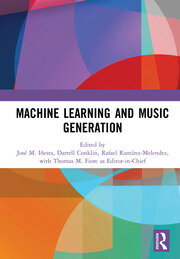
Machine Learning and Music Generation
Introduction: Machine learning and music generation 1. Chord sequence generation with semiotic patterns 2. A machine learning approach to ornamentation modeling and synthesis in jazz guitar 3. Analysis of analysis: Using machine learning to evaluate the importance of music parameters for Schenkerian analysis 4. Mapping between dynamic markings and performed loudness: a machine learning approach 5. Data-based melody generation through multi-objective evolutionary computation
Biography
José M. Iñesta is a Professor in the Department of Software and Computing Systems at the Universidad de Alicante, Spain.
Darrell Conklin is a Professor in the Department of Computer Science and Artificial Intelligence at the University of the Basque Country.
Rafael Ramírez-Melendez is Associate Professor in the Music Technology Group in the Department of Information and Communication Technologies at the Universidad Pompeu Fabra, Barcelona, Spain.
Thomas M. Fiore is Associate Professor of Mathematics at the University of Michigan-Dearborn, MI, USA.
