




1st Edition
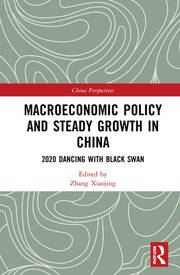
Macroeconomic Policy and Steady Growth in China 2020 Dancing with Black Swan
Edited By Zhang Xiaojing
Copyright 2022
318 Pages
122 B/W Illustrations
by
Routledge
318 Pages
122 B/W Illustrations
by
Routledge
318 Pages
122 B/W Illustrations
by
Routledge
Also available as eBook on:
Since the appearance of macroeconomics in the 1940s, economists have created many theoretical frameworks to explain the origin and mechanism of economic fluctuations. However, few of these have managed to gain explanatory power over reality; nor can they solve real-life problems. This book proposes a new macroeconomic paradigm that makes breakthroughs in these areas.
Based on a balance sheet... Read more
Preface. Part I Introduction. 1. Dancing with the black swan: the balance between economic growth and risk in a new paradigm (Zhang Xiaojing). Part II Stabilizing Growth. 2. The analysis and prospects of consumption (Li Cheng). 3. The analysis and prospects of investment in fixed assets (Liu Xueliang). 4. The analysis and prospects of international trade (Zhang Ying). Part III Stabilizing Leverage. 5. Analysis of the household leverage ratio (Zhang Xiaojing, Chang Xin and Liu Lei). 6. The analysis of the corporate leverage ratio (Zhang Xiaojing, Chang Xin and Liu Lei). 7. The analysis of government leverage ratio (Zhang Xiaojing, Chang Xin and Liu Lei). 8. The analysis of financial leverage ratio (Zhang Xiaojing, Chang Xin and Liu Lei). 9. The estimation of local governments’ hidden debt and its risks (Liu Lei). Part IV Stabilization Policy. 10. Analysis and outlook for fiscal policy (Liu Lei). 11. Analysis and outlook for monetary policy (Chen Hanpeng). 12. The global economic predicament and the transformation of China’s macroeconomic policy (Tang Duoduo). Afterword.
Biography
Zhang Xiaojing is a professor of economics and director of Institute of Finance & Banking (IFB), Chinese Academy of Social Sciences (CASS); director of National Institution for Finance & Development (NIFD); and a member of Chinese Economists 50 Forum. His research interests are open economy macroeconomics, macro finance, and development economics.
Wang Pinda is a graduate of Peking University. His research interests include labor economics and macroeconomics. He has translated books about macroeconomic policies of China.
