





1st Edition
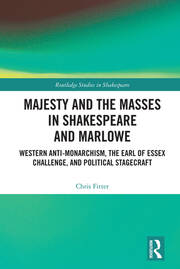
Majesty and the Masses in Shakespeare and Marlowe Western Anti-Monarchism, The Earl of Essex Challenge, and Political Stagecraft
Preface
PART ONE: THE DIVINE ROUT OF KINGS? WESTERN TRADITIONS IN NEGATION OF MONARCHY
Chapter 1: Surveying the Inheritance of Indictment
- Ancient Greece and Rome
- Biblical Legacies
- Late Antiquity and the Middle Ages
- The Reformation
- The Italian Renaissance, Humanist Values, Republican Thought
- Humanism and Republican Thought in England
- Tyranny and Resistance Theory
- Plebeian Perspectives and the Commonweal Touchstone
- Freedom of Speech
Chapter 2: Collapsing the Foundations of Tudor Sacral Kingship: Ernst Kantorowicz, Erasmus, and Sir Thomas Elyot
Chapter 3: Countering Monarchic Propaganda: Shakespeare and royalism, Marlowe’s Massacre at Paris, and Shakespeare’s Richard III
PART TWO: KINGSHIP AND THE ESSEX CHALLENGE
Chapter 4: Richard II as Elizabethans Received it: Dating, Dissidence, and Essex 1596 vs. Essex 1601
Chapter 5: Richard II and the Politics of Stagecraft: Audience Relations and the Negative Dialectic
Chapter 6: "Opposed Eyes": Popular Crisis, Class-Surveillance, and the Turn against Kingship in I Henry IV
Chapter 7: King Henry, Hotspur, Essex: Negating the Negation, and the Plebeian Commonweal Paradigm
Bibliography
Biography
Chris Fitter was educated at Oxford, taking his doctorate from St. John’s College. Professor of English at Rutgers University at Camden, his three previous books are Poetry, Space, Landscape: Toward a New Theory (Cambridge, 1994); Radical Shakespeare: Politics and Stagecraft in the Early Career (Routledge, 2012); Shakespeare and the Politics of Commoners: Digesting the New Social History (Oxford, 2017). He is author also of twenty journal essays and book chapters, and two dozen book reviews.
"Chris Fitter's survey of Western anti-monarchism "spans the first two chapters (134 pages), which review Greek, Roman, Biblical and medieval sources as well as an international set of humanists. The range here is impressive: more than forty writers, some of whom are represented in multiple texts. . . The quotations are well-chosen, and the overview is fascinating. . . Fitter handles the complexities of humanist statecraft in a compelling fashion. . .Energetic readings of plays keep their artistic status front and center, making a refreshing argument for political interpretation. . . Any future effort to locate Shakespeare in a royalist camp will have to reckon with this book."
--Theodore Nollert, Ben Jonson Journal
"Fitter builds his case with a mountain range of antimonarchic primary sources and counterintuitive close readings . . . [His] rigorous historical contextualization, attention to performance, and eye for the critique of power mark a methodology that could offer new and generative takes on the rest of Marlowe's dramatic corpus . . . The work proves that [Shakespeare] did not awaken to an antiauthoritarian dramaturgy with the stunning mid-career vision of King Lear, but that hostility to the crown is baked into the plays from the beginning."
--Robin Kello, Marlowe Newsletter
