





1st Edition
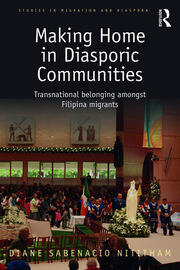
Making Home in Diasporic Communities Transnational belonging amongst Filipina migrants
Introduction 1. Conceptualising Home and Diaspora 2. Landscapes of Dislocation 3. ‘Our Noses Will Bleed and Then We Die’: Using Language as a Borderland Strategy 4. ‘Hey! Are you Filipino?’ Adapting Rituals, Religion and Routine 5. ‘As Long as You Have Your Food, You Feel at Home’: Eating, Gathering and Socializing 6. Romanticizing the Homeland 7. Working towards Home References Appendix A: Profile of Participants Appendix B: Interview Questions Appendix C: Notes on Terminology
Biography
Diane Nititham is a professor of sociology at Murray State University, USA. She specialises in migration, diaspora, and transnational communities, and is the co-editor of Heritage, Diaspora and the Consumption of Culture.
‘This book illuminates the lived experiences of an underrepresented group in Ireland and complicates discussions of globalization, migration, (national) identity and notions of home. It is a significant contribution to the field of Irish Studies and discourses on globalization, migration, and diaspora. Dr. Nititham gives a human face to seemingly abstract global economic and political forces.’ - Dr. Tanya Saroj Bakhru, San Jose State University, USA
'The first book to examine the lives of Filipina migrants in Ireland, Making Home in Diasporic Communities poignantly captures their day-to-day social practices, as they negotiate the politics of belonging in both Ireland and the Philippines. A must-read for all those interested in globalization and transnational belonging.' - Professor Yen Le Espiritu, University of California, San Diego, USA
'As one of the largest diasporas in the world, the Filipino diaspora is especially ripe for exploring questions of racialization, identity formation, transnationalism and belonging. Nititham provides a richly textured portrait of Filipina diasporans’ complex home-making strategies in Ireland. Her work is a unique contribution to Filipino diaspora studies that can serve as the basis for exciting comparative research.' - Robyn Rodriguez, University of California, Davis, USA
