




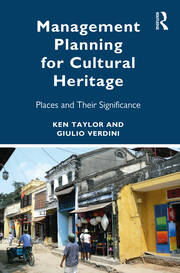
1st Edition
Management Planning for Cultural Heritage Places and Their Significance
1. Introduction: Context and politics of heritage management; Part I. Ideology of heritage; 2. Heritage and economic development; 3. Values and significance; 4. Charters, guiding principles, agencies; Part II Management Planning: Implementation and Techniques; 5. Documentation, assessment and analysis; 6. Management of heritage places; 7. Postscript
Biography
Ken Taylor is an Honorary Professor, Centre for Heritage & Museum Studies, Research School of Humanities and Arts, The Australian National University, Canberra, Australia; Emeritus Professor of Landscape Architecture, University of Canberra; Visiting Professor (2002 to 2023), Silpakorn University, Bangkok. He has published nationally and internationally on evolving global perspectives on cultural heritage management and cultural landscapes. He is a regular visitor to Asia and has lectured in various countries: China, India, Vietnam, Indonesia, and Japan in addition to Thailand.
Giulio Verdini is an urbanist holding a PhD in Urban and Regional Development from the University of Ferrara. He is a Reader in Urban Planning at the School of Architecture and Cities of the University of Westminster in the United Kingdom, and a Visiting Professor at the Mohammed VI Polytechnic University of Ben Guerir in Morocco. He regularly advises UNESCO regarding sustainable urban and rural heritage management practices with a specific focus on China and the Global South.
"Management Planning for Cultural Heritage provides a comprehensive analysis and practical set of tools for heritage professionals, scholars and students interested in place-based heritage management. In particular, two overarching themes are addressed in the book: first, understanding why a ‘heritage place’ should be conserved and managed; and second, examining which approaches will best safeguard the significance of the place. Importantly, both themes are elaborated with a much-needed human-centred perspective. Further, the book is not only useful but easy to use." ~ Haiming Yan, Chinese Academy of Cultural Heritage.
