




1st Edition
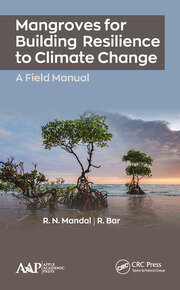
Mangroves for Building Resilience to Climate Change
Mangroves and Their History. Distribution and Diversity of Mangroves.
Ecology and Succession of Mangroves.
Adaptation and Phenology of Mangroves.
Classification and Identification of Mangroves.
Mangroves’ Responses to Climate Change and Management Options.
Management and Conservation of Mangroves.
Biography
R. N. Mandal, PhD is Principal Scientist, Indian Council of Agricultural Research, Central Institute of Freshwater Aquaculture (ICAR-CIFA), Rahara, Kolkata, West Bengal, India.
R. Bar, PhD, is Assistant Professor of botany at Bangabashi Morning College, University of Calcutta, India.
“This field manual explains in simple terms what scientific research has revealed about the mangrove plants, their environment, and how the plants and the environment interact. It provides an up-to-date account of the mangrove plants, their detailed identification and associations, their specific habitat requirements and adaptations, their reproductive strategies, and the management requirements of these plants to ensure their sustainability and conservation in a period where climate change provides acute challenges to this group of plants. The authors bring unique expertise and the passion to convey the latest information about these fascinating plants, ... thereby helping to reduce the threats that currently confront them.” —From the Foreword by Peter Saenger, Emeritus Professor, Centre for Coastal Management, School of Environment, Science & Engineering, Southern Cross University, Australia
