




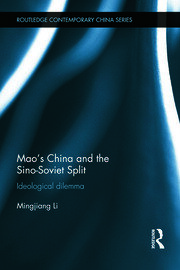

1st Edition
Mao’s China and the Sino-Soviet Split Ideological Dilemma
1. Introduction 2. Ideological Dilemma in International Politics 3. The Soviet 20th Party Congress and Emerging Disputes in 1958 4. Mao’s Great Leap Forward and Sino-Soviet Disputes, 1959-1960 5. Temporary Calm and Deterioration in Relations, 1960-1962 6. The Growth of Domestic Radicalism and Polemics with Moscow, 1963-1964 7. Short-lived Détente and the End of Party Relations, 1965-1966 8. Sino-Soviet Confrontation during the Cultural Revolution, 1966-1969. 9. Conclusions
Biography
Mingjiang Li is Assistant Professor at S. Rajaratnam School of International Studies (RSIS), Nanyang Technological University, Singapore.
"This short and succinct volume provides an interesting and important study of the role of ideology in foreign affairs. Though it can at times seem as if the book rather falls between the two stools of history and International Relations, it ultimately contributes to both, furthering our understanding of the Sino-Soviet rift as a historical event and helping to paint a more nuanced picture of the fluctuating influence of ideology on foreign policy." - Jens Hein, Energy, Environment and Development Programme, Chatham House; International Affairs 88: 5 (2012)
"Li’s book is much more than an exercise in theory. It has a wealth of information on the conduct of the ideological debate and of the decision-making process on the Chinese side." - Peter R. Moody, University of Notre Dame, USA; China Information 2013.
