





1st Edition
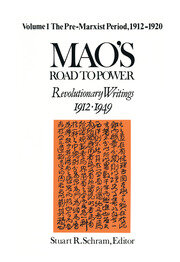
Mao's Road to Power: Revolutionary Writings, 1912-49: v. 1: Pre-Marxist Period, 1912-20 Revolutionary Writings, 1912-49
688 Pages
by
Routledge
688 Pages
by
Routledge
688 Pages
by
Routledge
Also available as eBook on:
Revolution in its Leninist guise has been a dominant force in the world for most of the 20th century, and the Chinese revolution has been, with the Russian revolution, one of its two most important manifestations. Mao Zedong, the architect of victory in China in 1949, stands out as one of the dominant figures of the century. Guerilla leader, strategist, conqueror, ruler, poet and philosopher, he... Read more
This book is designed to be the definitive statement on social equity theory and practice in public administration. Social equity is often referred to as the "third pillar" in PA, after efficiency and economy. It concerns itself with the fairness of the organization, its management, and its delivery of public services. H. George Frederickson is widely recognized as the originator of the concept and the person most associated with its development and application. The book's introduction and chapters 1-4 offer general descriptions of social equity in terms of its arguments and claims in changing political, economic, and social circumstances, and trace the development of the concept over the past forty years. Chapters 5-9 provide applications of social equity theory to particular policy arenas such as education, or to specific public administration issues such as the range of administrative discretion, the legal context, the research challenges, and social equity in the context of time and generations. Chapters 10 and 11 describe the current state of social equity and look towards the future.
Biography
Zedong Mao, Stuart Schram
