





1st Edition
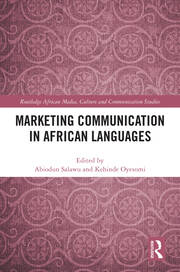
Marketing Communication in African Languages
Introduction: Marketing Communication In African Languages
Abiodun Salawu and Kehinde Oyesomi
Section A: African Traditional Advertising and Marketing
1. Advertising and Marketing in Traditional Yoruba Society in Nigeria
Yemisi Omolola Ilesanmi
Section B: Language Arts, Popular Culture, Advertising and Marketing
2. Becoming a Local Brand: Coca-Cola, Indigenous Languages and Evidence of Intimate ‘Glocalisation’ Among Young Africans in Nigeria and South Africa
Olutobi Akingbade and Harry Dugmore
3. Using Akan Language to Persuade in Digital Spaces: An Analysis of the Demand and Supply YouTube Channel
Abena A. Yeboah-Banin, Nicholas S.-D. Asante, Michael Etrue, Rachel G. A. Thompson, Clement K. I. Appah, and Modestus Fosu
4. Language Hierarchization in Marketing and Advertising: An Analysis of E-Advertisements from Zimbabwe’s Mobile Network Operators
Believe Mubonderi and Tavengwa Gwekwerere
5. Indigenous Marketing Styles in the Lyrics of Yoruba Popular Music Artists
Olayinka Abimbola Egbokhare, Israel Ayinla Fadipe, and Adeola Obafemi Mobolaji
Section C: Political Advertising, Marketing and Communication
6. (De)Marketing Political Products: An Analysis of the Branding of Malawian Political Leaders in Indigenous Languages (1964-2023)
Alick Kadango Bwanali, Jean Josephine Chavula-Hara, and Ahmmardouh Mjaya
7. Negative Political Advertising and the Entrenchment of Gender Norms in Indigenous Language Political Communication
Ganiyat Tijani-Adenle and Abiodun Salawu
8. “Tsotsitaal”: A Political Marketing Strategy by South Africa’s Main Political Parties Mopailo Thomas Thatelo
9. Political Marketing, Persuasion and Oratorical Whiz of Former Bophuthatswana Leader Lucas Mangope
Gilbert Motsaathebe
10. Advertising Robert Mugabe in Indigenous Languages: Readers’ Perspectives of Born Crew’s Get Connected
Jennings Joy Chibike
11. Indigenous Jingles in Political Messaging: Analysis of Yoruba Language Jingles in Nigeria’s 2023 Presidential Election on Selected Radio Stations in South-West Nigeria
Olanrewaju J. Ogundeyi, Nureni Aremu Bakenne, Tshepang B. Molale, and Abiodun Salawu
12. Perceived Influence of Indigenous Languages in Political Advertising during the 2023 General Elections among Residents of Ado-Odo/Ota Local Government, Ogun State, Nigeria
Babatunde Adeyeye and Abiodun Salawu
Section D: Commercials in African Languages
13. Using Indigenous Language Radio Advertisements to Build Brand Loyalty and Product Marketability of Selected SMMEs in South-West Nigeria
Olanrewaju J. Ogundeyi and Tshepang B. Molale
14. Reimagining Epistemic Decoloniality of Commercial Radio Advertising through African Languages for Sustainable Development in the Digital Age
Fulufhelo Oscar Makananise
15. Indigenous Language and Global Communication (Glo) Radio Advertisement in Igbesa Community, Ado-Odo Ota, Ogun State, Nigeria
Kehinde Oyesomi, Evaristus Adesina, and Babatunde Adeyeye
16. An Analysis of The Use of Indigenous Language in Radio Advertising on Social Media: A Case Study of Motsweding FM
Edgar Julius Malatji and Mamohlotlo Melbonia Mothiba
17. Gender Representation Using Indigenous African Languages in South African Television Advertisements
Shumani Eric Madima
Section E: Public Relations
18. Decolonising Public Relations Education in South Africa: A Case of the Lemba People
Sefoloko Vhangani Mabada
19. A Public Relations Perspective of “Emi lo kan” As An Indigenous Political Marketing Slogan of All Progressive Congress Presidential Candidate in the 2023 Nigeria General Elections
Oludare Ebenezer Ogunyombo and Olanrewaju Olugbenga Akinola
Section F: Branding, Corporate and Public Communication
20. ‘My Language, My Brand’: Reflections on Oko Oloyun’s Exclusive Yoruba Language for SME Branding
Akintayo Adesoji Ogunsanya, Jendele Hungbo, and Abiodun Salawu
21. An Analysis of The Use of Indigenous Languages in Corporate Communication at The North-West University
Mamohlotlo Melbonia Mothiba and Edgar Julius Malatji
22. The Use of African Languages in China's Brand Advertising: Revisiting the Localization and Standardization Debates
Yowei Kang and Kenneth C.C. Yang
Biography
Abiodun Salawu is Professor of Journalism, Communication, and Media Studies and Director of the research entity, Indigenous Language Media in Africa (ILMA), at the North- West University, South Africa. He has taught and researched journalism, media and communication for close to three decades in Nigeria and South Africa. Prior to his academic career, he practised journalism in a number of print media organisations in Nigeria. He has, to his credit, well over a gross of scholarly publications in academic journals and books. He has also edited/ co- edited 13 books and authored 1. He is a regular presenter of papers at local and international conferences. He is a co- vice chair of the journalism section of the International Association for Media and Communication Research (IAMCR) and a member of editorial/ advisory boards of a number of journals. He was involved in the founding of the International Association for Minority Language Media Research. He is rated by the NRF as an established researcher at the level of C1 (with international recognition), and he is a member of Codesria’s College of Senior Academic Mentors. He is a Fellow of the Nigerian Academy of Letters and Member Royal Society of South Africa.
Kehinde Oyesomi holds B.Sc. (2004), M.Sc. (2006) and Ph.D. (2013) degrees in mass communication. She also obtained a post-doctoral fellowship in communications from North-West University, South Africa, in 2018. Kehinde Oyesomi is Associate Professor of Communication and Media Studies and also the immediate past Head of Department, Mass Communication, Covenant University. She is currently the Editor-in-Chief of Covenant Journal of Communication. She has 17 years of working experience spanning journalism, corporate communications and teaching. Award winner during her undergraduate (Best student in Media Planning, overall best student in Public Relations and Advertising), NYSC days in Enugu State where she researched and wrote a book on HIV/AIDS that was circulated around secondary schools in the State, and she has won several research papers and grant awards both nationally and internationally. Recently, she was presented the Lecturer of the Year award for her role of supervisory responsibilities to the Covenant University student who won the gold medal at the Future Creative Leader Academy among other 20 institutions. Oyesomi has since traversed wider terrains in different but related fields of media and gender, development communication, journalism and public relations. Dr. Oyesomi is a member of the International Association for Minority Language Media Research (IAMLMR), African Council for Communication Education (ACCE), Association of Communication Scholars and Professionals of Nigeria (ACSPN), Nigerian Institute of Public Relations (NIPR), Advertising Practitioners Council of Nigeria (APCON), International Advertising Association (IAA), South African Communications Association (SACOMM), Council for the Development of Social Science Research in Africa (CODESRIA) among other local and international bodies and fora, and she is a reviewer and editorial board member for several local and international journals. She has published in several local and international high-impact journals. She also has book chapters and an edited book to her credit.
For continent in its post-colonial phase of development, Marketing Communication in African Languages, is a timely scholarly masterpiece as it addresses the extant challenge of dearth of scholarly attention to use of indigenous languages as vehicles of marketing communication on the African continent. The book epitomizes a renaissance of the use of indigenous languages in scholarship, commerce, entertainment and marketing of candidates during periodic democratic elections across the African continent.
Rotimi Olatunji, Professor, Public Relations & Advertising, Faculty of Communication and Media Studies, Lagos State University, Ojo, Lagos, Nigeria.
The landmark work done in this book offers a rich and diverse compilation of the key areas of marketing communications, where African languages have played prominent roles with successful outcomes. The pioneering effort of the authors deserves a commendable thumbs-up in their effort to showcase the beauty and the uncharted utility value in the use of African languages in marketing.
Olugbenga C. Ayeni, Professor, Department of Business Administration, College of Business, Eastern Connecticut State University, USA.
