




1st Edition
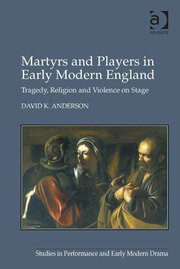
Martyrs and Players in Early Modern England Tragedy, Religion and Violence on Stage
By David K. Anderson
Copyright 2014
252 Pages
by
Routledge
252 Pages
by
Routledge
252 Pages
by
Routledge
Also available as eBook on:
Focusing on Christopher Marlowe, William Shakespeare, John Webster and John Milton, Martyrs and Players in Early Modern England argues that the English tragedians reflected an unease within the culture to acts of religious violence. David Anderson explores a link between the unstable emotional response of society to religious executions in the Tudor-Stuart period, and the revival of tragic drama... Read more
Tragedy and Religious Violence in Early Modern England; Chapter 1 Violence against the Sacred; Chapter 2 The Tragedy of Gravity; Chapter 3 Tragic Part Icipation; Chapter 4 Tragic Complicity; Chapter 5 Tragic Ambivalence;
Biography
David K. Anderson is Assistant Professor of English at the University of Oklahoma, USA. He hails from Ontario, Canada.
'Martyrs and Players presents a fresh and forceful argument about the early modern stage and does so with eloquence and verve. Drawing out the tensions between politics and theology, David Anderson makes the compelling case that religious persecution was the motivating context for early modern tragedy. This book asks important questions about tragedy and violence that have relevance far beyond early modern studies. Anderson succeeds in bringing together history, theology and genre theory without ever losing sight of either early modern theatre as the key institution of his study, or of the importance of detailed engagement with the literary texts. Most importantly, this book brilliantly takes on the critical reluctance to engage religious problems as anything other than a manifestation of essentially political power struggles.' Dympna C. Callaghan, Syracuse University, USA 'While scholars have long insisted on the cultural importance of the Acts and Monuments, very few have gone so far as to actually read it. Anderson writes with authority, grace and fine-grained attention to the literary merits and impact of Foxe upon major authors in the early modern moment, complicating our understandings of early modern violence, contemporary attitudes to state power, and the power of literature to register both.' Claire McEachern, University of California, Los Angeles, USA 'The book raises very effectively the question of how issues which, by and large, might be taken to be political ones, may have translated onto the stage and into literary texts.' British Catholic History
