



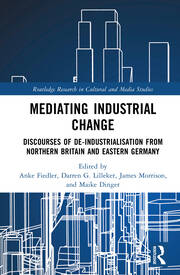
1st Edition
Mediating Industrial Change Discourses of De-Industrialisation from Northern Britain and Eastern Germany
1. Why (De)industrialisation Matters for Communication and Media Studies, Anke Fiedler, Darren Lilleker, James Morrison and Maike Dinger Part 1. Public Constructions of (De-)Industrialisation 2. The Watt-Gorger: Creating Public Energy Knowledge in the Early German Democratic Republic, Mario Bianchini; 3. From Capital to Coalfield: Revisiting ‘Darkest England’, James Morrison; 4. Do Extremist Miners Threaten Public Welfare? A Study on the Bourgeois Press Coverage of the British and German Coal Strikes in 1912, Lukas Wierschowski; 5. On the Structural Change of ‘Strukturwandel’ in Media Discourse: The Discursive Transformation of a Key Concept in the Case of Lusatia, Anke Fiedler; 6. Lusatia as a Laboratory for the Future? Depictions of Lusatia’s Regional Future in Media Discourse during the Coal Phase-Out Debate, Anna Abel and Natalia Kalauch; 7. External Gazes, Local Self-Perception: Mediated Marginality and (De-) industrialisation in the Mini-Series Lauchhammer – Death in Lusatia (2022), Andy Räder; 8. Life on the Dole: Resisting Stigma Through Social Memory in Post-Industrial Newcastle-upon-Tyne, Helen Tracey Part 2. Perceptions of (De-)Industrialisation 9. Hollow Centres: Exploring the (Lack of) Post-Industrial Community, Maike Dinger and Darren Lilleker; 10. ‘There Used to Be a Mine, It Was Shut Down’: an Exploration of the Lasting Impacts of Pit Closure, Catherine Mills and Ian McIntosh; 11. What is an Alternative? Examining the Effects of Political Frustration in Three East German (Post-)Industrial Towns, Julian Linn; 12. Invisible Labour: AI, Migrant Labour and the Racialised Political Economy of Platform Capitalism, Kostas Maronitis; 13. Cultural Trauma and Migration in Post-1990 East Germany: Remembering Deindustrialisation and the Intensification of Racist Exclusion in Elder Care, Monique Ritter; 14. Gender in Transition – Structural Change and Regional Development in East Germany: The Case of Lusatia, Anja Mutschler, Leonie Liemich, Bernadette Rohlf, and Julia Gabler; 15. Caring for the Ruins of the Industrial Past: Women as Community-Builders and Working Wives and Mothers in England’s Industrial North, Maike Dinger and Darren Lilleker; Index
Biography
Anke Fiedler is a Senior Lecturer and Researcher in Communication Studies in the Department of Political Science and Communication Studies at the University of Greifswald, Germany. Her research focuses on communication history, particularly the control of the media in the German Democratic Republic, the role of the media in (post-)socialist transformation, and memory studies. Since 2024, she has been the principal investigator of the DFG/AHRC-funded project ‘Voices from the Periphery: (De)constructing and Contesting Public Narratives about Post-Industrial Marginalisation’. She is also the co-editor of the book Media and Past Conflict in Europe: Dynamics of Mediation and Power (2025).
Darren G. Lilleker is Professor of Political Communication in The Faculty of Media, Science & Technology, Bournemouth University, UK and Convenor of the Centre for Comparative Politics & Media Research. He is UK principal investigator of the AHRC/DFG-funded project ‘Voices from the Periphery: (De)constructing and Contesting Public Narratives about Post-Industrial Marginalisation’.
James Morrison is an Associate Professor in Journalism Studies at the University of Stirling, UK, and the author of a number of books, including Scroungers, The Left Behind and The Workless. He is UK Co-investigator on the AHRC/DFG-funded project ‘Voices from the Periphery: (De)constructing and Contesting Public Narratives about Post-industrial Marginalisation’.
Maike Dinger is a Postdoctoral Researcher on the AHRC-/DFG-funded project ‘Voices from the Periphery: (De-)Constructing and Contesting Public Narratives about Post-Industrial Marginalization’ with Bournemouth University and Stirling University, UK. Her interdisciplinary research focuses on the connections between politics, media, national(ist) cultures and identities, with a view to social and political marginalisation and intersectional exclusions.
