




1st Edition
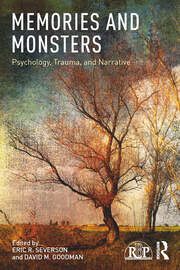
Memories and Monsters Psychology, Trauma, and Narrative
Introduction: Listening to Monsters Eric Severson and David Goodman
Chapter 1: Apocalyptic Exceptionalism and Existential Particularity: The Rise in Popularity of Dystopian Myths and our Immortal "Other" Paul Cantz, PSYD, ABPP
Chapter 2: The Golem Must Live, the Golem Must Die: On the Moral Imperative of Writing Critical Cultural Histories of Psychology Philip Cushman
Chapter 3: The Golem and the Decline of Language and Magic—Or, Why Our Machines Disappoint Joel Rosenberg
Chapter 4: Is Loyalty Really A Virtue? Shame and the Monstrous Other Peter Shabad
Chapter 5: Toward A Psychoanalysis of Passion Jerome A. Miller
Chapter 6: Living in the Shadows of the Past: German Memory, Trauma and Legacies of Perpetration Roger Frie
Chapter 7: Haunting & Historicity Jerome Veith
Chapter 8: Changing Societal Narratives, Fighting "Crimes Against Humanity" Doris Brothers, Ph.D.
Chapter 9: Positioning Self and Other: How Psychiatric Patients, Psychiatric Inmates, and Mental Health Care Professionals Construct Discursively their Relationship to Total Institutions Branca Telles Ribeiro and Diana Souza Pinto
Chapter 10: "I am not myself, but I am not an other": Self-dissolution Narrative in Medical Rehabilitation Psychotherapy Orin Segal
Chapter 11: Idealized "Other": A Reparative Fiction Amira Simha-Alpern, Ph.D.
Chapter 12: Foucault and Derrida on Interiority and the Limits of Psychoanalyzing Sexuality and Madness Peter Capretto
Chapter 13: Beautiful Troubling Alterity: An Intersubjective Response to Nabokov's Lolita Steven Huett and George Horton
Chapter 14: The Music Knows: Grieving Existential Trauma In Art, Music and Psychoanalysis Malcolm Owen Slavin, Ph.D.
Biography
Eric R. Severson is a philosopher specializing in the work of Emmanuel Levinas. He is author of the books Levinas's Philosophy of Time (Duquesne University Press, 2013) and Scandalous Obligation (Beacon Hill Press, 2011), and editor of several volumes on ethics, philosophy of religion and psychology. He currently teaches philosophy at Seattle University.
David M. Goodman is a licensed clinical psychologist, Associate Dean of Academic Affairs and Advising at the Woods College of Advancing Studies at Boston College, Director of the Psychology and the Other Institute, and a teaching associate at Harvard Medical School/Cambridge Hospital.
"This is a top-quality volume. Severson, Goodman and a stellar collection of contributors do a great job of weaving a diverse range of approaches to the topic together into a book that sheds really fresh insight on a subject first raised by Freud, and revisited by many within and outside psychoanalysis ever since."-Donna M. Orange
