





1st Edition
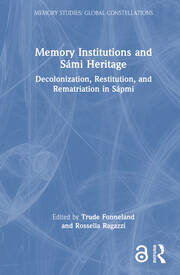
Memory Institutions and Sámi Heritage Decolonization, Restitution, and Rematriation in Sápmi
Introduction
Trude Fonneland and Rossella Ragazzi
1. Máhttsat ja Mujttalit: Árran’s Negotiations in the Bååstede Project
Eli-Anita Øivand Schøning
2. Old Sea Sámi Artefacts and New Museum Practices
Eva Dagny Johansen
3. From DigiJoik to Luohtevuorká: Appropriation and Appreciation in the Process of Making New Homes for Luođit
Camilla Brattland, Trude Fonneland, and Rossella Ragazzi
4. Drum Time: Tracing the Multifaceted Significances and Stories of a Sámi Drum
Dikka Storm and Trude Fonneland
5. The Hagenbeck Sámi Collection at Museum Europäischer Kulturen in Berlin
Cathrine Baglo
6. The Nordnorsk Kunstmuseum: A Case Study in Decolonization
Sarah Annemarie Caufield
7. Imagining the “Otherwises” of Indigenous Sámi Art: (De)coloniality in Sámi Dáiddamuseax and “The Sámi Pavilion”
Katrine Rugeldal
8. Upon Return, a NewArctic: A Collaborative Museum Experiment
Gro B. Ween
9. Gállogieddi Caput Sápmi
Erika De Vivo
10. The Sacred Mountain: The Heritage-Making of Sálašoaivi/Tromsdalstinden
Giacomo Nerici
Afterword: Memory Institutions and the Cultural Politics of Appreciation
Laura Junka-Aikio
Biography
Trude Fonneland is a professor of cultural studies at UiT The Arctic University Museum of Norway. Her research interests include Sámi cultural heritage, museology, and contemporary shamanism. She is co-author of Sámi Religion: Religious Identities, Practices, and Dynamics (2020) and Shamanic Materialities in Nordic Climates (2023).
Rossella Ragazzi is an associate professor of museum and media anthropology at UiT The Arctic University Museum of Norway. Her current research interests explore critial theories of heritage within Sámi museums. She is the author of Walking on Uneven Paths: The Transcultural Experience of Children entering Europe in the Years 2000 (2009) and has co-edited two volumes of Nordic Museologi, focusing on Sámi Museums heritage and museums.
"Memory Institutions and Sámi Heritage addresses the timely topic of how museums, archives, galleries, festivals, etc. deal with their colonial legacy and with an urgent need to revise their role, position, and perceptions on cultural heritage. This volume is an invaluable contribution to the ongoing work of understanding the consequences and implications of the decolonial turn for memory institutions in Sápmi and in other Indigenous contexts."
Coppélie Cocq, Professor in Sámi Studies and Digital Humanities and Assistant Director of Humlab, Umeå University, Sweden
"This is a collection of well-researched case studies hitting the very core of heritage theory by its explorations of the intrinsic power relations and colonial aspects of museum work. Applying these perspectives to Sámi culture has a double advantage. It gives insights into Sámi cultural expressions as they have moved and been moved from everyday life into museums and other memory institutions, driven by different agendas and agents. Doing so, it also demonstrates the ontological implications of phenomena like restitution, decolonization, and repatriation (or rematriation, referring critically to the gendered concepts of nation and fatherland). At the same time, the book is an important contribution to memory and museum studies more generally, showing the conceptual complexities as well as the practical challenges that follow from shifting the focus from artifacts to agents or from heritage to heirs to autonomous Sámi agency."
Anne Eriksen, Professor of Cultural History, IKOS, University of Oslo, Norway
"I recommend this book highly for its enlightening presentation of new and thought-provoking perspectives on past and contemporary presentations of Indigenous Sámi culture in memory institutions and beyond. Understood as ongoing processes of change in a decolonizing perspective, the contexts of the analyzed examples range from museums to festivals, music, art, and tourism. Where earlier power imbalances caused appropriation and misrepresentations of their culture, today’s presenters have to establish new communicative positions and new ways of cooperating with Indigenous groups. To readers involved in any presentations of Sámi heritage the book would be inspirational, and would bring greater understanding to the general, interested audience."
Stein R. Mathisen, Professor Emeritus, Department of Tourism & Northern Studies, UiT The Arctic University of Norway, Norway
"One of the most striking features of this insightful collection of essays is the importance accorded to introducing, explaining and applying Sámi terminology, concepts, and epistemologies as tools to understand historical and contemporary dynamics pertaining to Sámi memory and cultural heritage. This approach not only imparts meaning and substance to the processes of Sámi decolonization and (re)appropriation, but also discloses new, exciting theoretical, methodological, and practice-based perspectives on the work of museums and memory institutions in a postcolonial world – in Sámi, Indigenous, and non-Indigenous contexts alike."
Marzia Varutti, Marie Skłodowska-Curie research fellow, Swiss Center for Affective Sciences, University of Geneva, Switzerland
