




1st Edition
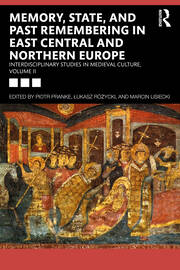
Memory, State, and Past Remembering in East Central and Northern Europe Interdisciplinary Studies in Medieval Culture, Volume II
List of Contributors
Chapter 1 Memory of the Past: John Lydos on the Origins of Rome and Roman Offices in the Period of Kings
Szymon Olszaniec
Chapter 2 Macedonia between Two Worlds: Roman and Barbaricum (7th-9th Centuries)
Mitko B. Panov
Chapter 3 Testimonies and Questions Related to the Elite Formation Process: The Case of Antes (4th–7th Centuries)
Georgios Kardaras
Chapter 4 (In)Visible Members of the Society: Children and Adolescents as Seen in a Tenth-Century Collection of Miracle Stories in Medieval Bulgaria
Yanko M. Hristov
Chapter 5 "Rome" in the Early Piast state
Przemysław Urbańczyk
Chapter 6 Memory of the Battle of Hlyrskógsheiðr and the Medieval Development of the Cult of St. Óláfr
Jakub Morawiec
Chapter 7 Lady of Cassel and Her Polish Mercenaries: The Story of the Creation of a Duchy
Tamás Ölbei
Chapter 8 Charlemagne in Medieval Illuminations: Representations of Religious and Temporal Power at the Crossroads of the West and the East
Sabina Madgearu
Chapter 9 The Battle of Cedynia – Memory vs. History: Around 1050th Anniversary of the Events of 972 in Cidini
Stanisław Rosik
Chapter 10 Imagination of Royal Power and Monarchy in Polish Cultural Texts for Children and Youth
Marcin Lisiecki
Chapter 11 The Nature of the Rulers Power in the Grand Duchy of Lithuania in 13th and 14th Centuries
Yanina Ryier
Chapter 12 Hungarian Border Defence Strategy Against Early Hussite Invasions
Imre Solt Varga
Chapter 13 Some Considerations on the Emergence of the Moldavian State (13th-14th Centuries)
Alexandru Madgearu
Chapter 14 "It Was Said Near the ‘Tower’ of Mstislav": Accounts of the Rus’ Princes from Deszt–i–Kipczak on the Example of Mstislav Mstislavovich and Danilo Romanovich
Dariusz Dąbrowski
Chapter 15 Two Kings in One Realm: King Béla IV of Hungary and his Younger Brother, Prince Coloman
Gábor Barabás
Chapter 16 The Romanness of the Master Vincentius’s Account of Bolesław the Wrymouth’s Campaign against Nakło (Chronica Polonorum, III.14–17)
Radosław Kotecki
Chapter 17 Magister Vincentius’ Tales of Power: Roman Decor of the Early Piast Monarchy in the Chronica Polonorum
Franciszek Dąbrowski
Chapter 18 Rome, Christianity and the Empire: Did Piasts Need External Legitimization of Their Power: Second Half of the 10th Century to the Beginning of the 12th Century.
Przemysław Wiszewski
Biography
Piotr Pranke is an assistant professor who deals with the history of medieval Scandinavia and Central and Eastern Europe, and is a member of the Faculty of Historical Sciences at the Nicolaus Copernicus University in Toruń, Poland. His scientifc interests include the history of trade in the Viking era and the history of the Ottonian Empire and its infuence on the shaping of the areas of East Central and Northern Europe.
Łukasz Różycki is Professor of History at Adam Mickiewicz University, Poznań, Poland. His main research interests include the study of Roman and Byzantine theory of warfare, with a particular focus on military treatises.
Marcin Lisiecki is Professor at the Nicolaus Copernicus University in Toruń; works at the Faculty of Humanities of the Nicolaus Copernicus University; his scientific interests focus, among others, on around popular culture, animated film and research on myths.
