





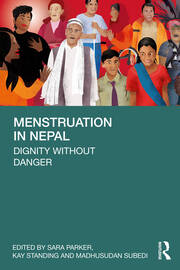
1st Edition
Menstruation in Nepal Dignity Without Danger
List of Figures x
List of Tables xi
Author Biographies xii
Acknowledgements xxi
1 Introduction 1
Sara Parker, Kay Standing and Madhusudan Subedi
2 An Overview of Menstrual Normativity in Nepal 18
Stefanie Lotter and Neeti Aryal Khanal
3 Sanskrit Texts and Contemporary Menstrual Taboos in South Asia 35
Lidia Wojtczak
4 “It Is Women’s Blood. It Is Their Curse” Continuity and Change in the Interpretation and Practice of Menstrual Exclusion across Three Generations in Nepal 45
Mira Mishra
5 The Politics of Breaking the Chhau Goth: The Experiences of Young Dalit Women in Achham 62
Neeti Aryal Khanal
6 Fluidity in Practise: Exploring Menstrual Practices in Baglung 79
Lina Baniya and Sara Parker
7 Society or the Law? “No Matter What Law Comes, This Society Won’t Stop Practising Chhaupadi”: A Discussion on the Causes and Implications of Menstrual Restrictions in Dailekh District 96
Josephine McAllister, Melanie Channon, Mahesh C. Puri, Fran Amery and Jennifer Thomson
8 From Fear to Shame: Socio-political Influences on Menstruation Practice in the Hill and Mountain Region of West Nepal 115
Rajya Laxmi Gurung and Stefanie Lotter
9 Issues on Menstrual Hygiene Practices, Restrictions, and Perceptions: A Need to Strengthen Menstrual Health Education 130
Evangeline Clarke and Aditi Luitel
10 ‘Dignity’ and ‘Freedom’ Kits: Insights into Re-usable Menstrual Pads in Nepal 145
Sara Parker and Kay Standing
11 Using Participatory Filmmaking with School Adolescents on Menstrual Hygiene Management in a School in the Chitwan District of Nepal 164
Sudha Ghimire, Gyanu Maharjan, Bhimsen Devkota, Astrid T. Sinnes and Bishal K. Sitaula
12 Menstruators with Disabilities: The Population Left Behind by Menstrual Health Management 179
Sapana Basnet, Rose Khatri and Sarita Lamichhane
13 In Search of Dignified Menstruation in Western Nepal: Evidence from the Field 191
Sanna-Leena Rautanen, Pamela White and Kalpana Dishwa
14 Dignified Menstruation and Educational Initiatives of Menstrual Health and Hygiene Management Partners’ Alliance in Nepal 206
Guna Raj Shrestha and Ganga Ram Gautam
15 Dignified Menstruation in Nepal and Beyond 222
Radha Paudel, Manamaya Pangeni Bhattarai and Mili Adhikari
16 Working Vertically and Horizontally: A Comprehensive Theoretical Framework for Addressing the Harmful Effects of Menstrual Traditions in Nepal 236
Sara E. Baumann, Müge Finkel, Pema Lhaki and Jessica G. Burke
17 Conclusion and the Way Forward 253
Madhusudan Subedi, Sara Parker and Kay Standing
Biography
Sara Parker is a Reader in Development Studies and is Principal Investigator on the British Academy Global Challenge Research Fund Sustainable Development Programme–funded project entitled Dignity Without Danger: Collaboratively Analysing Stigma and Taboos to Develop Innovative Strategies to Address Menstrual Exclusion in Nepal.
Kay Standing is Professor in Gender Studies at Liverpool John Moore’s University, United Kingdom. She has been involved in research on gender and education in Nepal since 2003 and has published extensively in both academic and media/online publications.
Madhusudan Subedi is a Professor of Sociology and teaches medical, public health, and nursing students at Patan Academy of Health Sciences and MA and MPhil students at the Central Department of Sociology, Tribhuvan University, Nepal.
“Menstruation in Nepal: Dignity without Danger, embarks on a profound journey to illuminate this essential yet often neglected aspect of women's lives. The authors bring together a rich tapestry of perspectives, combining academic insights, personal narratives, and grassroots experiences. This book reflects the complexity of the subject matter and invites readers to engage with menstruation in a way that transcends the limitations of a singular viewpoint. It urges readers to reflect on their own preconceptions, question societal norms, and actively participate in fostering an environment where menstruation is approached with dignity, respect, and understanding. It is a clarion call to policymakers, educators, and students to collectively engage in reshaping the narrative surrounding menstruation.”
Professor Bindu Pokharel, Department of Gender Studies, Tribhuvan University, Nepal
“Very few topics are so clearly divided by gender as menstruation. It is women who bear the burden of society’s attitudes towards menstruation in particular and to women’s bodies more generally. The contributors highlight the important influence of religion, culture, and social stratification (caste) on the issue. The editors must be congratulated on bringing together such a wide range of different collaborators. It is worth remembering that culture is hard to change. Nepal has made progress but at the same time there is still a long way to go. I strongly recommend Menstruation in Nepal Dignity without Danger to readers interested in health and development in Nepal, those interested in culture and society in South Asia, people interested in gender and social change and others with related interests. However, I recommend this excellent volume even stronger to men in Nepal, fathers, husbands, partners, and sons, to help them gain insight into the trials and tribulations that accompany people who menstruate in their daily lives.”
Professor Edwin van Teijlingen, Bournemouth University, UK
