




1st Edition
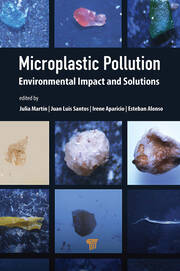
Microplastic Pollution Environmental Impact and Solutions
1. Microplastic Contamination: An Introduction to an Emerging Issue (Prof. Julia Martín et al., Scopus ID: 35488348500)
2. Analysis of Microplastics in Environmental Water by Pyrolysis-GC/MS (Prof. Luìcia H.M.L.M. Santos et al., Scopus ID: 55947204900)
3. Analysis of Microplastics and Small Microplastics (<100 µm) in Natural Waters via Micro-FTIR (Prof. Fabiana Corami et al., Scopus ID: 7801412352)
4. Occurrence, Characteristics, and Removal of Microplastics in Wastewater Treatment Plants (Prof. F.J. Bayo Bernal et al., Scopus ID: 7004332116)
5. Distribution of Marine Debris in the Mangroves of a Semi-enclosed Lagoon System (Prof. Behara Satyanarayana et al., Scopus ID: 7003346054)
6. Microplastic Pollution in Mountain Environments (Prof. Paolo Pastorino and Damià Barceló, Scopus ID: 6701494091)
7. Microplastic Pollution in Antarctic Environments (Prof. Gabriel E. De-la-Torre et al., Scopus ID: 57219465541)
8. Microplastics as a Vector of Hazardous Contaminants: Plastic Chemicals, Digestive Physiology and the Need for Chemical Simplification (Prof. Farhan R. Khan et al., Scopus ID: 35315742500)
9. Microplastics as Potential Vector of Antibiotics in Aquatic Media: Environmental Implications (Prof. Esteban Alonso et al., Scopus ID: 55890374200)
10. Effects of Petroleum and Bio-micro(nano)plastics on Aquatic Organisms (Prof. Miguel Oliveira et al., Scopus ID: 57219552003)
Biography
Julia Martín is assistant professor of analytical chemistry, and her most relevant scientific contributions are in the field of environmental analytical chemistry, focusing on the dynamics of priority and emerging contaminants in different environmental scenarios and industrial facilities. She has participated in 25 research projects and contracts with companies and public institutions. She has published more than 120 scientific articles (h-index 42) and 30 book chapters.
Juan Luis Santos is full professor in the Department of Analytical Chemistry of the University of Seville, Spain. He is member of the research group Anquimed since 2004. He is an expert in chromatography and mass spectrometric analysis, has participated in more than 50 research projects and contracts, and is co-author of more than 130 scientific papers focused on the dynamics of organic and inorganic pollutants in the environment and on evaluating the environmental impact of these pollutants on organisms within affected environmental compartments.
Irene Aparicio is a full professor; secretary of the Department of Analytical Chemistry of the University of Seville, Spain; and a member of the research group Anquimed (Industrial and Environmental Chemical Analysis), since 2004. Her research is focused on the development of analytical methodologies for the determination of organic contaminants, mainly pharmaceuticals and metabolites, in environmental matrices and their application to fate, removal, and risk assessment studies.
Esteban Alonso is a full professor and director of the Department of Analytical Chemistry at the University of Seville. In 2004, he founded the research group Anquimed (Industrial and Environmental Chemical Analysis), with the purpose of improving specifically the knowledge about the dynamics of priority and emerging pollutants in several environmental scenarios and industrial installations. Before joining the University of Seville, he worked at the Center for New Water Technologies, a non-profit association of private firms and government agencies focused on the field of novel water technologies.
