




1st Edition
Migration, Aging and Japan's Sustainable Society
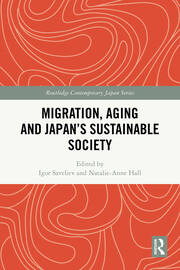
This book analyzes the relationship between migration and social sustainability in Japan and examines the transformation of its foreign-national and ethnic minority population over the past thirty years while critically assessing Japan’s immigration and integration policies and their domestic and inter-regional social effects.
Foreword
Introduction
Igor Saveliev
PART I Patterns of Migration and Settlement in Japan and Creating a Sustainable Society
Chapter 1. Thirty years of migration in Japan and the sustainability of existing modes
Igor Saveliev
Chapter 2. Japan’s Chinese community in transformation and its symbolic representations
Shentong Zhang, Huijing Zhang and Igor Saveliev
Chapter 3. From a Vietnamese village to a Japanese factory: transforming migration patterns of Vietnamese technical interns
Yasuyo Nagasaka (translated by Igor Saveliev)
Chapter 4. Is nurse migration under Economic Partnership Agreements sustainable?
Yuko O. Hirano
Chapter 5. Indians in Japan: becoming visible in a ‘closed’ society
Varvara S. Firsova
PART II Discrimination and social vulnerabilities
Chapter 6. Understanding online racism in Japan in global and local context
Natalie-Anne Hall
Chapter 7 Aging as a Korean resident in Japan: Minority care-giving and the construction of collective memory
Naoko Ito (translated by Igor Saveliev)
Chapter 8 Aging and care for Returnees from China: Facets of intercultural care in a postcolonial world
Shoko Sakabe and Jingan Jin (Translated by Natalie-Anne Hall)
Conclusion: Japan’s multi-ethnic future
Natalie-Anne Hall
Biography
Igor Saveliev is Professor of History and Cultural Anthropology at the Graduate School of Humanities, Nagoya University, Japan.
Natalie-Anne Hall is a Lecturer in the School of Social Sciences, Cardiff University, UK.
Migration, Aging, and Japan's Sustainable Society provides essential insights into how Japan is dealing with demographic change by instrumentalizing immigration, as well as the responses of migrants and their communities. It is required reading for anyone interested in contemporary Japanese society and global migration issues.
(Sven Saaler, Sophia University, Tokyo)
