




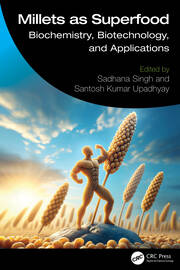
1st Edition
Millets as Superfood Biochemistry, Biotechnology, and Applications
Chapter 01 A Comprehensive Overview of Millets: Evolution, Cultivation and Uses
Akhouri Nishant Bhanu, M. Yasin, Anjuri Srivastav, and Sadhana Singh
Chapter 02 Nutritional Composition of Millets
Zoomi Singh
Chapter 03 Millet Biochemistry: An Overview
Nor Anis Nadhirah Md Nasir, A. K. M. Aminul Islam, Quraazah Akeemu Amin, Irnis Azura Zakarya, and Sara Yasina Yusof
Chapter 04 Millets and the Environment: A Climate-Smart Solution for Sustainable Agriculture
Kane-Potaka J, Anitha S, Miruthika Devi SA, Grando S, and VaraPrasad
Chapter 05 Genetic Diversity and Breeding of Major Millets – A Global Perspective
Hussein Shimelis, Maliata Athon Wanga, Adane Gebreyohannes, Armel Rouamba, Seltene Abady Tesfamariam, Elisabeth P. Zida, and Fatma Sarsu
Chapter 06 Global and Indian Initiatives for Millet Promotion
Radha Shivhare and Charu Lata
Chapter 07 Advanced Biotechnological tools for millet improvement
Shashi Ranjan, Sam. A Masih, Aman Prakash, and Ann Maxton
Chapter 08 Bioactive Compounds in Millets
Urvashi Sharma and Yoya Luithui
Chapter 09 Millet Cultivation Practices
Sonia Goel, Prashant Vikram Singh, Mohinder Singh, and Abidemi Talabi
Chapter 10 Post-Harvest Handling of Millets: Threshing, Drying, Processing and Storage
M. Ahiduzzaman, Quraazah Akeemu Amin, Manzoor Dar, Nor Anis Nadhirah Md. Nasir, and A. K. M. Aminul Islam
Chapter 11 Fortification, Value-Addition and Innovations in Millet-Based Product Development
Quraazah Akeemu Amin, Irtiqa Amin, Towseef Ahmed Wani, Nor Anis Nadhirah Md. Nasir, M. Ahiduzzaman, and A. K. M. Aminul Islam
Chapter 12 Millets as Multifunctional Grains for Modern Health Challenges
S. Anitha, J. Kane-Potaka, Raj Bhandari, and Madhuvanti Kale
Chapter 13 Millet-Based Food Products
Poonam Tiwari, Mahima Gupta, and Janmejai Kumar Srivastava
Chapter 14 Evaluation of the Potential of Millets in Emerging Markets: Opportunities and Sustainability
Sunil Kumar and Rinku Jhamta
Chapter 15 Role of Millets in Food Security and Sustainable Agriculture
Aditi Jain, Ashwani Kumar, and D. K. Bhatt
Chapter 16 Challenges and Future Direction in Millets Research
Amaan Arif and Prachi Srivastava
Chapter 17 Economic and Social Aspects of Millet Production
Kiran Kushwaha, Prachi Bhargava, Vaishnavi, Sana Rahman, and Prachi Srivastava
Chapter 18 Millets in Livestock Feed and Animal Nutrition
Neetu Mishra and Jyoti Tiwari
Biography
Sadhana Singh is working as an Assistant Professor, School of Sciences, U.P. Rajarshi Tandon Open University (UPRTOU), Prayagraj, India. She has completed her PhD in Plant Biotechnology, from Bharathiar University (DRDO-BU Centre for Life Sciences), Coimbatore, (TN), India. She did her post-doctoral research from International Crops Research Institute for the Semi-Arid Tropics (ICRISAT), Patancheru, India. Her research interests include—plant stress tolerance (model and non-model); molecular regulations controlling plant abiotic stresses; role of NAC genes towards abiotic stress tolerance; transcriptional profiling of stress responsive genes (RAN, NAC, GPAT); identification and characterization of candidate genes in semi-arid legumes against legumes against drought; role of NAC genes towards cold/salt/drought/response, biomass enhancement, carbon trapping and sequestration, etc., using functional genomics approach (genomics, transcriptomics, proteomics, and genome editing). She has published over 20 research/review articles in peer-reviewed international journals in addition to many book chapters (Wiley; Springer) on essential aspects of plant biotechnology and plant stress tolerance. She has been serving as a reviewer of many reputed journals that include—Functional and Integrative Genomics; Genes; 3 Biotech; Physiology and Molecular Biology of Plants; Plant Signaling and Behavior; Molecular Biology Reports; G3: Genes | Genomes | Genetics; Frontiers in Plant Science; Scientific Reports; Forests; Agriculture; Plant Biotechnology Reports; BMC Genomics; BMC Plant Biology; and International Journal of Molecular Sciences. Additionally, she is also an editor of the Frontiers in Genome Editing (Review Editor); Genomics of Plants and the Phytoecosystems (Guest Associate Editor), Biotechnology and Bioinformatics (Mediterranean Journals). She has been the recipient of several awards and honours that include—National Post Doc Fellowship, DST-SERB, India. She has also been invited to Webinars as a panelist and speaker for [IECPS 2024] SESSION F. Plant Molecular Biology and Plant Genetics, Genomics and Biotechnology on the Title—CRISPR/Cas-Mediated Genome Editing in Legumes on 16 January 2024 (MDPI). In short, she works as a vibrant, self-governing expert/scientist to connect her knowledge towards designing stress-smart, better-quality, and high yielding varieties of crop plants.
Santosh Kumar Upadhyay has been working as an Assistant Professor at the Department of Botany, Panjab University, Chandigarh, India for more than 10 years. After completing his doctoral work at the CSIR-National Botanical Research Institute, Lucknow, he served as DST-INSPIRE Faculty at the National Agri-Food Biotechnology Institute, Department of Biotechnology, Government of India, Mohali, for one and half years. Thereafter, he has been serving as an Assistant Professor at Panjab University (PU). He is currently working on the area of functional genomics using various computational approaches. During his doctoral research, he was involved in the characterization of various insect toxic proteins, such as lectins, chitin-binding proteins, etc., from plant biodiversity. Currently, his research group at PU has characterized numerous important cation transporters including calcium cation antiporters, monovalent cation transporters, calcium ATPases, and important defence-related protein families such as receptor-like kinases, anti-oxidant enzymes, etc., of bread wheat. They are also characterizing long non-coding RNAs related to the abiotic and biotic stress responses. He has also demonstrated the method of genome editing in bread wheat and potato using the CRISPR-Cas system for functional genomics studies and developed a tool SSFinder for CRISPR target site prediction. He has authored more than 100 publications including research papers in leading journals of international repute, national and international patents, book chapters, and books. In recognition of his strong credentials and contributions, he has been awarded the NAAS Young Scientist Award (2017–18) and NAAS-Associate (2018) from the National Academy of Agricultural Sciences, India, INSA Medal for Young Scientist (2013) from the Indian National Science Academy, India, NASI- Young Scientist Platinum Jubilee Award (2012) from the National Academy of Sciences, India, and Alltech Young Scientist Award (2011). He has also been the recipient of the prestigious DSTINSPIRE Faculty Fellowship (2012), and SERB-Early Career Research Award, (2016) from the Ministry of Science and Technology, Government of India, and several research grants from various funding agencies like SERB, DBT, CSIR, etc. He also serves as a member of the editorial board and reviewer of many peer-reviewed international journals.
