




1st Edition
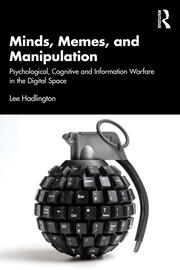
Minds, Memes, and Manipulation Psychological, Cognitive and Information Warfare in the Digital Space
Preface
1. The Digital Battlefield.
2. Understanding your Digital Adversary.
3. Defining the Terrain: Disinformation and Misinformation.
4. Exploring Minds: The Cognitive Vulnerabilities Exploited in the Digital Battlespace.
5. Hacking the Wetware: Age, Personality, and Gender in Digital Warfare
6. Cognitive Biases in Digital Warfare I: Disrupting Information Processing and Risk Perception.
7. Cognitive Biases II: Social and Emotional Biases in Digital Warfare
8. Weaponising Influence: Social Engineering in Digital Warfare
9. The Battle for Decisions: The Role of Memory and Heuristics
10. Manipulation of Credibility Online
11. Fake News and Information Warfare.
12. Disinformation and Information Warfare.
13. Online Radicalisation.
14. Memetic Warfare: How Ideas Become Weapons Online
15. Conspiracy Theories
16. Countering the Digital Threat: Strategies for Digital Resilience
Glossary
Biography
Lee Hadlington is Associate Professor of Cyberpsychology at Nottingham Trent University, UK, and a member of the Cyberpsychology Research Group. His research focuses on aspects of risk and resilience iin cyberspace, with a particular emphasis on susceptibility to cybercrime, fake news and misinformation, cybersecurity, and information security. He has published extensively on the topic of human factors and cybersecurity, as well as other work focusing on the role of individuals in the proliferation of misinformation and attitudes towards AI in defence settings.
