





1st Edition
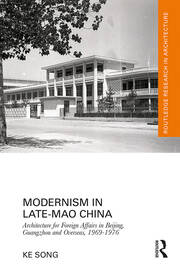
Modernism in Late-Mao China Architecture for Foreign Affairs in Beijing, Guangzhou and Overseas, 1969–1976
List of Figures
List of Tables
Foreword
Preface (by Jianfei Zhu)
Acknowledgements
Chapter 1: Introduction
Chapter 2: Rethinking Modernism: Form, Knowledge and Politics
Chapter 3: Political Ideology and Architectural Discourse in Mao’s China
Chapter 4: Chinese Modernism in the 1950s and the 1960s
Chapter 5: Diplomatic Buildings in the 1970s Beijing
Chapter 6: Foreign Trade Buildings in the 1970s Guangzhou
Chapter 7: China’s Foreign Aid Architecture, 1964-1976
Chapter 8: Conclusion
Bibliography
Glossary
Index
Biography
Ke Song is an Associate Professor at the School of Architecture, Harbin Institute of Technology, Shenzhen. His research is centred on architectural history of modern China with a focus on the period after 1949. He has published papers in prestigious journals, including Architectural Histories, ABE Journal: Architecture beyond Europe, Fabrications and Architectural Journal (Chinese). He has taught both design studios and theory subjects in China and Australia, and has working experience at several architectural design firms, including CPG Corporation (Singapore), Teamminus (Beijing) and Lab Architects (Melbourne). He is now working on several projects of heritage conservation and urban public space in Shenzhen. In 2019, he co-founded Urban Drifting, a not-for-profit platform based in Shenzhen, aiming to promote public awareness about urban history through series of walking tours guided by smart phone application.
