





1st Edition
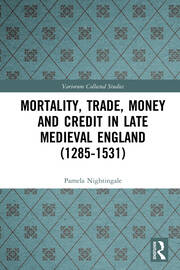
Mortality, Trade, Money and Credit in Late Medieval England (1285-1531)
1 Some new evidence of crises and trends of mortality in late medieval England
Past & Present, 2005, vol. 187, issue 1, pp. 33–68. Re-printed by permission of The Past and Present Society, Oxford University Press
2 Alien finance and the development of the medieval English economy, 1285–1511
The Economic History Review, 2012, vol. 66, issue 2, pp. 477–496. Re-printed by permission of the Economic History Society, John Wiley & Sons
3 The impact of crises on credit in the late medieval English economy
A.T. Brown, A. Burn and R. Doherty (eds), Crises in Economic and Social History: A Comparative Perspective, Boydell Press, 2015. Re-printed with the permission of the Boydell Press
4 English medieval weight standards revisited
British Numismatic Journal, vol. 78, British Numismatic Society, London, 2008. Re-printed with the permission of the Society
5 Finance on the frontier: money and credit in Northumberland, Westmorland and Cumberland, in the later middle ages
M. Allen & D’M Coffman (eds), Money, Prices, and Wages: Essays in Honour of Professor Nicholas Mayhew, 2015. Reprinted with permission of Palgrave Macmillan
6 The intervention of the crown and the effectiveness of the sheriff in the execution of judicial writs, c. 1355–1530
The English Historical Review, 2008, vol. CXXIII, issue 500, pp. 1–34. By permission of Oxford University Press
7 The rise and decline of medieval York: a reassessment
Past & Present, 2010, vol. 206, issue 1, pp. 3–42. By permission of The Past and Present Society, Oxford University Press
8 The rise of London as a financial capital in late medieval England
M. Lorenzini, C. Lorandini and D’M. Coffman (eds), Financing in Europe: Evolution, Coexistence and Complementarity of Lending Practices from the Middle Ages to Modern Times, 2018. Reprinted by permission from Palgrave Macmillan
9 Gold, credit, and mortality: distinguishing deflationary pressures on the late medieval English economy
The Economic History Review, 2010, vol. 63, issue 4, pp. 1081–1104, Re-printed with the permission of The Economic History Society, John Wiley & Sons
10 Credit and the effect of the Black Death on regional commercial economies, 1350–1369
Previously unpublished
11 A crisis of credit in the fifteenth century, or of historical interpretation?
British Numismatic Journal, vol. 83, British Numismatic Society, London, 2013. Re-printed with the permission of the society
Biography
Pamela Nightingale was a scholar of Newnham College, Cambridge, where, for her Ph.D., she worked on the history of the East India Company in the eighteenth century. Her thesis was published in 1970 as Trade and Empire in Western India, 1784–1806, by Cambridge University Press. While her three children were young she taught for the Open University and subsequently published further books on British India and Kashgar in Chinese Central Asia, before making the major change of subject involved in writing A Medieval Mercantile Community. This focused on the Grocers' Company of London and its part in the economic and political developments of the city and of the medieval English economy. In 1999 she was elected a member of Oxford University's History Faculty, and in 2010 she was awarded an Oxford D. Litt degree. She is also a fellow of the Royal Historical Society.
