





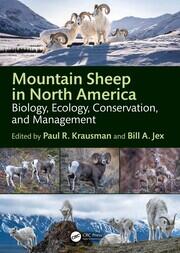
1st Edition
Mountain Sheep in North America Biology, Ecology, Conservation, and Management
Section 1: Biology and Ecology
Chapter 1. Origin, classification, and distribution of mountain sheep in North America
Raul Valdez
Chapter 2. Historical trends in mountain sheep populations and their habitats
Raul Valdez, Paul R. Krausman, and Bill A. Jex
Chapter 3. Range wide status of mountain sheep
Daryl W. Lutz, Froylan Hernandez, and Darren L. Bruning
Chapter 4. Physical characteristics and horn development
Kevin L Monteith, Seth T. Rankins, Jaron T. Kolek, and Tayler N. Lasharr
Chapter 5. Social behavior and reproductive strategies
Marco Festa-Bianchet and Fanie Pelletier
Chapter 6. Application of genetics to taxonomy, biology, conservation, and management
Clinton W. Epps, Michael Buchalski, Joshua P. Jahner, and Zijian Sim
Chapter 7. Nutritional ecology of mountain sheep: From bites to populations
Kristin Denryter and Thomas R. Stephenson
Chapter 8. Diseases
Michael W. Miller, Karen A. Fox, Margo J. Pybus, and Helen M. Schwantje
Chapter 9. Relationships among mountain sheep and their predators
Brian F. Wakeling, Vernon C. Bleich, Marcus E. Blum, and Justin A. Dellinger
Chapter 10. Competition among mountain sheep and other ungulates
Jericho C. Whiting, Vernon C. Bleich, and Tom Smith
Chapter 11. Seasonal migrations and other movements
Blake Lowrey
Chapter 12. Weather, water, and precipitation
James W. Cain III and Madelon Van De Kerk
Section 2: Population Management
Chapter 13. Mountain sheep survey methods
Vernon C. Bleich, Daryl W. Lutz, Marcus E. Blum, Danielle M. Glass, Steven G. Torres, and Jericho C. Whiting
Chapter 14. Capture and translocation of mountain sheep
Daryl W. Lutz and Vernon C. Bleich
Chapter 15. Modeling population dynamics of mountain sheep
Mark S. Boyce and Evelyn H. Merrill
Chapter 16. Harvest management of mountain sheep in North America
Chadwick P. Lehman, Todd J. Brinkman, and Brad R. Wendling
Chapter 17. Mountain sheep management in Mexico
Raul Valdez, Ray Lee, Hugo Sotelo Gallardo, and Juan M. Segundo Galán
Chapter 18. Human dimensions and mountain sheep
Kathryn A. Schoenecker, Nicholas W. Cole, and Saeideh Esmaeili
Section 3: Habitat, Climate Change, and Conflicts
Chapter 19. Characteristics of habitat for mountain sheep
Paul R. Krausman
Chapter 20. Habitat management: key to mountain sheep conservation
James C. deVos, Jr. and Raymond M. Lee
Chapter 21. Threats to mountain sheep habitat
Bill A. Jex
Chapter 22. Conflict Management
Brian F. Wakeling, Stephen L. Webb, Jeffrey W. Gagnon, Emily S. Almberg, and Jared T. Beaver
Section 4: Science Related Management Opportunities
Chapter 23. Long-term research on individual sheep
Marco Festa-Bianchet and Fanie Pelletier
Chapter 24. Challenges for mountain sheep management and conservation in North America
Paul R. Krausman and Bill A. Jex
Biography
Paul R. Krausman was an Assistant Professor at Auburn University (1976-1978), Professor of Wildlife Conservation and Management at the University of Arizona (1978-2007), and Boone and Crockett Professor at the University of Montana (2007-2015). He is currently Professor Emeritus at the University of Arizona, Editor of the Conservation and Management Book Series published by Johns Hopkins University Press and The Wildlife Society. He was raised in North Africa, Europe, and Asia before returning to the United States where he earned degrees from The Ohio State University (B.S., Zoology), New Mexico State University (M.S., Wildlife Management), the University of Idaho (Ph.D.,1976), and was awarded the Aldo Leopold Medal from The Wildlife Society in 2006. Paul was also a Visiting Professor at the Wildlife Institute of India, Dehra Dun, intermittently (1989-2000) and at the Universidade de Trás-os- Montes e Alto Douro, Vila Real, Portugal (2005-2006). He is also the recipient of the Desert Ram Award from the Desert Bighorn Council (2000). Paul has numerous journal and book publications and has been the editor of the Desert Bighorn Council Transactions, The Journal of Wildlife Management, and Wildlife Monographs, and has been an associate and guest editor for 5 other journals. Paul is a Certified Wildlife Biologist, Wildlife Fellow, Honorary Member of The Wildlife Society, and served as faculty advisor to the student chapters of The Wildlife Society at Auburn, Arizona, and Montana. Dr. Krausman has taught an array of wildlife-related classes throughout his career, including Scientific Writing for Publication, Big Game Ecology, and Applied Wildlife Management. He has directed nearly 100 graduate students on ungulate and predator studies throughout the United States and in India. The most rewarding aspect of his career is the development of the future leaders in the wildlife profession—students. He currently lives with his wife and an assemblage of animals in Santa Fe, New Mexico.
Bill A. Jex always had a keen interest in the outdoors and started working in the natural resources field in Ontario, Canada in 1984. He graduated from Sir Sandford Fleming College in 1989 as a Fish and Wildlife Technologist while doing some teaching along the way. Since graduation, Bill has worked in the fisheries, wildlife, habitat, enforcement, and regulatory fields. Beginning in 1996, Bill started employment with the Province of British Columbia, and since 2018, he has represented the province as its first Wild Sheep and Mountain Goat Specialist, before retiring in 2025. He continues to support the province in enforcement roles as a provincial wild sheep expert, and also supports non-government organizations as a member of the Wild Sheep Foundation's Professional Resource Advisory Board, the Rocky Mountain Goat Alliance's Science and Conservation Committee, a member of the Northern Wild Sheep and Goat Council, and as a collaborator with the Western Association of Fish and Wildlife Agencies' Wild Sheep Initiative. Bill was one of the first Technologists to become accepted as a Registered Professional Biologist in British Columbia, in 2001. Currently, Bill works with the Wild Sheep Foundation and the Wild Sheep Society of British Columbia, and continues to support research with universities, conservation-focused organizations, and Indigenous Governments on wild sheep and mountain goat issues. He also supports, edits, and authors scientific and popular articles and conducts public education workshops. Mountain sheep and goats, and especially thinhorn sheep, are truly special to Bill. These animals live where few can: on the tops of the world and the edge of the earth, where the line between the land and sky is at times obscured by clouds or blinded in sunshine. Bill’s goal is to continue to work for the conservation and management of mountain ungulates so future generations can be inspired by their resilience and majesty, and the places they live. Bill currently lives in Smithers, British Columbia with his lovely wife of 30 years, and their two dogs, a Chocolate Lab and Golden Retriever.
