





1st Edition
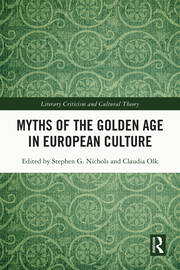
Myths of the Golden Age in European Culture
List of Contributors
Preface
Claudia Olk and Stephen G. Nichols,
Introduction
Oliver Primavesi
Chapter 1: Hesiod and Empedocles on the Decline of Humankind
Stephen G. Nichols
Chapter 2: Eros and Eris in Hesiod’s Myth of the Golden Age
Jack I. Abecassis
Chapter 3: In defense of the Evil Brother, an Interpretation of Hesiod’s Works and Days
Daniel Heller-Roazen
Chapter 4: The Oldest Reading: Prometheus and the Arts of Divination
Brian J. Reilly
Chapter 5: “Immeasurably Preferred to Gold”: The Saintly Age of Medieval Christian Salvation
Gaia Gubbini
Chapter 6: After the End: The Troubadours, the Golden Age, and a Fading Civilization
Claudia Olk
Chapter 7: ‘T’excel the Golden Age’: Golden Worlds in the English Renaissance
Joachim Küpper
Chapter 8: Patriarchal Fantasies and Proto-Feminist Libertarianism: Don Quijote’s Praise of the Golden Age and Marcela’s Plea for Freedom
Andreas Höfele
Chapter 9: The Golden Age Restored, London 1616: Court Entertainment and Stuart Politics
David E. Wellbery
Chapter 10: The Golden Age in the Age of Goethe
Michael Lackner
Chapter 11: One Golden Age? Or many? Chinese Conceptions of the Ideal Society
Index
Biography
Stephen G. Nichols is the James M. Beall Professor Emeritus and Academy Professor of French and Humanities at Johns Hopkins University. He is a Fellow of the American Academy of Arts and Sciences, a Fellow of the Medieval Academy of America, an Honorary Senior Fellow of the School of Criticism and Theory (which he directed from 1996-2001). He received an honorary Docteur dès Lettres from the University of Geneva, is an Officier de l’Ordre des Arts et Lettres (France) and was awarded the Alexander von Humboldt Foundation Research Prize in 2008, 2015, and 2023. A Yale University Ph.D. in Comparative Literature, he has written or edited some 27 books on the Middle Ages, including Romanesque Signs: Early Medieval Narrative and Iconography, which received MLA’s Lowell Prize for an outstanding book, and From Parchment to Cyberspace: Medieval Literature in the Digital Age. Nichols co-directs JHU’s Digital Library of Medieval Manuscripts and co-founded the journal Digital Philology.
Claudia Olk is chair of English and Director of the Shakespeare Library at Ludwig- Maximilians-Universität München. Until 2019 she was chair of Comparative Literature at the Peter Szondi Institute of the Freie Universität Berlin and Dean of the Faculty of Philosophy and the Humanities. Her main fields of research are Medieval and Renaissance Literature, Shakespeare Studies as well as Modernism. She is a member of the Bavarian Academy of Sciences and Humanities and served as President of the German Shakespeare Society from 2014-2023. Her publications include: Travel and Narration: the development of fiction in late medieval and renaissance travel narratives (1999), Virginia Woolf's Aesthetics of Vision (2014), and Shakespeare and Beckett: Restless Echoes (2023). Her edition of one of Virginia Woolf's hitherto unpublished manuscripts was published in 2013 by the British Library.
