




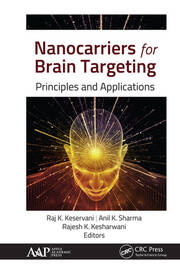
1st Edition
Nanocarriers for Brain Targeting Principles and Applications
Part 1: Introduction To Carriers In Brain Targeting
1. Carriers for Brain Targeting: Recent Advances and Challenges
Md. Sahab Uddin and Mst. Marium Begum
2. The Blood-Brain Barrier and Advanced Carriers for Brain Drug Delivery and Targeting
Ali Sadeghinia et al.
3. Nanotechnology for Brain Targeting
Debjani Banerjee, Huma Shamshad, and Nidhi Mishra
4. Nanocarriers for Brain Targeting: An Overview
B. A. Aderibigbe, I. A. Aderibigbe, and A. P. I Popoola
5. Natural Biopolymeric Nanoformulations for Brain Drug Delivery
Josef Jampílek and Katarína Králová
Part 2: Particulate Carriers
6. Nanoparticulate Drug Delivery Systems for Brain Targeting
Emil Joseph, Gautam Singhvi, and Saswata Banerjee
7. Nanocapsules in Brain Targeting
Soumya Nair and Jayanthi Abraham
8. Solid Lipid Nanoparticles for Brain Targeting
M. M. De Araujo et al.
9. An Introductory Note on Quantum Dots for Brain Targeting
Kirti Rani
10. Graphene for Brain Targeting
S. J. Owonubi et al.
Part 3: Vesicular Carriers
11. A Brief Account of Liposomes for Brain Delivery
D. B. Borin and R. C. V. Santos
12. Liposomal Drug Carriers: Principles, Formulation Perspectives, and Potentials for Brain Drug Delivery
Juliana Palma Abriata et al.
13. Niosomes for Brain Targeting
Didem Ag Seleci et al.
Part 4: Other Issues
14. Nanoemulsions for Brain Targeting
Khushwinder Kaur and Shivani Uppal
15. Nanogels for Brain Targeting: Introduction, Formulation Aspects, and Applications
Nagarjun Rangaraj and Sunitha Sampathi
16. Applications of Nanocarriers in Emerging and Re-Emerging CNS Tropical Infections
S. Yasri and V. Wiwanitkit
Biography
<b>Raj K. Keservani, MPharm,</b> is a faculty of pharmaceutics at Sagar Institute of Research and Technology-Pharmacy, Bhopal, India. He has more than seven years of academic (teaching) experience from various institutes of India in pharmaceutical education. He has published 30 peer-reviewed papers in the field of pharmaceutical sciences in national and international journals, fifteen book chapters, two co-authored books, and two edited books. He is also active as a reviewer for several international scientific journals. Mr. Keservani graduated with a pharmacy degree from the Department of Pharmacy, Kumaun University, Nainital (UA), India. He received his Master of Pharmacy (MPharm) (specialization in pharmaceutics) from the School of Pharmaceutical Sciences, Rajiv Gandhi Proudyogiki Vishwavidyalaya, Bhopal, India. His research interests include nutraceutical and functional foods, novel drug delivery systems (NDDS), transdermal drug delivery/ drug delivery, health science, cancer biology, and neurobiology.
<b>Anil K. Sharma, MPharm,</b> is working as a lecturer at the Delhi Institute of Pharmaceutical Sciences and Research, University of Delhi, India. He has more than six years of academic experience in pharmaceutical sciences. He has published 26 peer-reviewed papers in the field of pharmaceutical sciences in national and international journals as well as 12 book chapters. He received a bachelor’s degree in pharmacy from the University of Rajasthan, Jaipur, India, and a Master of Pharmacy degree from the School of Pharmaceutical Sciences, Rajiv Gandhi Proudyogiki Vishwavidyalaya, Bhopal, India, with a specialization in pharmaceutics. His research interests encompass nutraceutical and functional foods, novel drug delivery systems (NDDS), drug delivery, nanotechnology, health science/life science, and biology/cancer biology/neurobiology.
<b>Rajesh K. Kesharwani, PhD, is affiliated with the Department of Advanced Science & Technology, NIET, Nims University Rajasthan, Jaipur, India. He has more than seven years of research and two years of teaching experience in various institutes of India, imparting bioinformatics and biotechnology education. He has received several awards, including the NASI-Swarna Jayanti Puruskar-2013 by The National Academy of Sciences of India. He has authored over 32 peer-reviewed articles and ten book chapters. He has been a member of many scientific communities as well as a reviewer for many international journals. Dr. Kesharwani received a BSc in biology from Ewing Christian College, Allahabad, India, an autonomous college of the University of Allahabad; his MSc (Biochemistry) from Awadesh Pratap Singh University, Rewa, Madhya Pradesh, India; and MTech-IT (specialization in Bioinformatics) from the Indian Institute of Information Technology, Allahabad, India. He earned his PhD from the Indian Institute of Information Technology, Allahabad, and received a Ministry of Human Resource Development (India) Fellowship and Senior Research Fellowship from the Indian Council of Medical Research, India. His research fields of interest are medical informatics, protein structure and function prediction, computer-aided drug designing, structural biology, drug delivery, cancer biology, and next-generation sequence analysis.
