




1st Edition
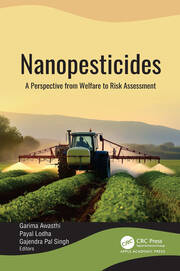
Nanopesticides A Perspective from Welfare to Risk Assessment
Introduction
1. An Introduction to Nanopesticides
Vishwa Patel, Vaibhav Sharma, Darshini Trivedi, Meenakshi Singh, and K. Chandrasekhar
2. Destiny of Nanopesticides in Soil and Water
Supriya Kumari, Surbhi Kumari, Kumud Kant Awasthi, Anjali Awasthi, and Rajbala Verma
3. Nanopesticide Communication to Soil Microorganisms
Neelam Poonar, Poonam Meena, and Archana Meena
4. Configuration and Preparation Methods of Nanopesticides
Varad Nagar, Anuj Sharma, Mahipal Singh Sankhala, Kamakshi Pandey, and Garima Awasthi
5. Categories of Nanopesticides Used for Crop Protection
Shivangi Giri, Lata Shahani, Dev Saini, Sujata Sharma, and Kumud Kant Awasthi
6. A Systematic Approach to Phytoremediation: Using Nanocarriers and Its Current Perspectives
Vinay Aseri, Rushikesh L. Chopade, Apoorva Singh, Kumud Kant Awasthi, Mahipal Singh Sankhla, and Garima Awasthi
7. Interaction of Nanopesticides with Plants
Apexa Pareek, Renu Sharma, Tara Maheshwari, and Payal Lodha
8. Economical and Market Status of Nanopesticides
Vinay Aseri, Poonam Kumari, Vanisha Godara, Garima Awasthi, Tarun Kumar Kumawat, Shalini Fagna, G. P. Singh, and Harsh Pandey
9. Environmental Risk Assessment of Nanopesticides
Pavan Kumar Ganechary, Tanisha Gupta, and Chandra Shekhar Yadav
10. Impact of Nanopesticides on Non-Targeted Organisms
Tushar R. Ahire, Sukanya Sachdeva, Divya Kottadiyil, and Perumal Sivaperumal
Biography
Garima Awasthi, PhD, is a Professor at K. R. Mangalam University, Haryana, India. She was formerly an Associate Professor at Vivekananda Global University, India. She also worked as a SERB-National Postdoctoral Fellow at the University of Lucknow. In recent years, she has published more than 60 scientific articles on heavy metal stress in plants, mainly focusing on arsenic problems in rice. She has been a reviewer of scientific manuscripts for international scientific publishers. Her research covers the areas of plant abiotic and biotic stress, nanotechnology, plant physiology, and proteomics. She has collaborated with various educational institutions and research centers, as well as with the industrial sector.
Payal Lodha, PhD, is a Professor of Botany at the University of Rajasthan Jaipur, India, where she is also serving as a convenor of the Board of Studies (Botany). She also served as a pool officer (scientist, CSIR), Assistant Professor, and Associate Professor at the university. She has more than 30 years of research experience in the field of plant-nematode interactions and has published more than 60 research and review articles. Professor Lodha was deputed by the University of Rajasthan to assist the Govt. of Rajasthan to organize the International Rajasthani Conclave–2000 (IRC–2000). She presented a paper at the 2004 World Congress on In Vitro Biology at San Francisco, California, USA.
Gajendra Pal Singh, PhD, is a Professor of Botany at the University of Rajasthan, Jaipur, India, where he earlier worked as Associate Professor and Assistant Professor. His area of research interest is the rapid response time of the algal community to changing environmental conditions and the effect of various mutagens on growth and productivity of algal products. With more than 30 years of teaching and research experience, he has published more than 100 research papers and has organized international and national conferences. In addition to being a researcher, he is an active administrator and has held various reputed positions. He has delivered keynote lectures and invited talks at international and national conferences.
