




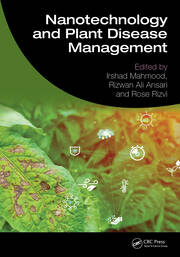
1st Edition
Nanotechnology and Plant Disease Management
Chapter 1: Nanotechnology: A New Frontier in Sustainable Agricultural Pest and Disease Management
Magda Mahmoud Amin Sabbour, Mehmet Ramazan Rişvanlı and Gökhan Boyno
Chapter 2: Revolutionizing Nematode Management – Nanomaterials as a Promising Approach for Managing Economically Important Plant-Parasitic Nematodes: Current Knowledge and Future Challenges
Mahfouz M. M. Abd-Elgawad
Chapter 3: Exploring the Potential of Nanomaterials in a Crusade against Plant Disease Management
Arsh Rehan Siddiqui, Rizwan Ali Ansari, Aisha Sumbul, Rose Rizvi, Noor Fatima, Safiuddin Safiuddin, Atul Upadhyay, Uma Shankar Rajput and Irshad Mahmood
Chapter 4: Nanosensors: An Emerging Tool for Early Detection of Plant Pathogens in Sustainable Agriculture
Sozan E. El-Abeid, Rizwan Ali Ansari, Mohamed A. Mosa, Ahmed G. Soliman, Ahmed M. Saleh, Jamila Boudaden and Dina S. S. Ibrahim
Chapter 5: Nanoparticles from Microbes: The Next Generation Tool for Combatting Plant Diseases
Gökhan Boyno, Necmettin Teniz, Emre Demirer Durak, Younes Rezaee Danesh and Semra Demir
Chapter 6: Bio-Nanomaterials: The Next-Generation Weapon against Plant-Parasitic Nematodes in Commercial Crops
Gökhan Boyno, Mehmet Ramazan Rişvanlı, Sozan E. El-Abeid, Mohamed A. Mosa and Dina S. S. Ibrahim,
Chapter 7: Maximizing the Potential of Nanoparticles for Sustainable Plant Pathogen Management: Addressing Phytotoxicity and Residues
Geeta Rautela, Aiman Zafar, Aisha Sumbul, Rizwan Ali Ansari, Irshad Mahmood, Arsh Rehan Siddiqui and Rose Rizvi
Chapter 8: Exploring the Potential of Microbe-Mediated Gold Nanoparticles in Sustainable Plant Pathogen Management
Abdulmujib Gboyega Yusuf, Tesleem Taye Bello and Oluwatoyin Adenike Fabiyi
Chapter 9: Bio-Fabrication of Nanomaterials and Their Application in Plant Disease Management: Scope, Challenges and Strategies
Dina S. S. Ibrahim, Rizwan Ali Ansari, Sozan E. El-Abeid, Manal Mostafa, Fayrouz M. Saeed and Ahmed Ghannouchi
Chapter 10: Nanoengineering for Sustainable Crop Health: Leveraging the Potential of Nanotechnology in Enhancing Disease Resistance and Yield Improvement
Manjunath Hubballi, Rizwan Ali Ansari, Rose Rizvi, Noor Fatima, Noah Totsline, Archana A.M., Charanpreet Kaur and Archana T. S.
Chapter 11: Management of Plant Disease Using Nanotechnology: A Paradigm Shift in Crop Protection
Tesleem Taye Bello, Abdulmujib Yusuf, Taofeek T. Adegboyega and Oluwatoyin Fabiyi
Biography
Irshad Mahmood, an erudite Professor of Plant Pathology and Nematology in the Department of Botany, Aligarh Muslim University, Aligarh. He obtained his Ph.D. degree from Aligarh Muslim University in the field of Plant Pathology and Nematology. He has been engaged with the teaching programme of undergraduate and post-graduate level students for the last 30 years and has made many overseas visits, including to the United States, France and the UK. He has attended a significant number of national and international conferences on a wide area of agricultural sciences and has published around 150 original research papers, review articles and book chapters in various refereed national and international publications. He has successfully completed many training courses in various ICAR sponsored research institutes in India and also at North Carolina State University, Raleigh, USA. He is also an active member of national and international scientific organizations, served as an expert for selection committees, reviewer of journals, doctoral theses and funding agencies, and is a recipient of a scientist of the year award in the field of Plant Pathology and Nematology. He has guided ten Ph.D., several M. Phil. students and a large number of M.Sc. dissertations.
Rizwan Ali Ansari, Assistant Professor in the Department of Plant Protection, Faculty of Agricultural Sciences at Aligarh Muslim University in India, is a highly accomplished scholar in the field of Plant Pathology/Nematology. His academic credentials include a Ph.D. from the same institution, where he has actively engaged in cutting-edge research and development strategies that have revolutionized the field. Dr. Ansari has formulated innovative management modules that leverage a wide array of microorganisms, antagonists and organic additives to combat a diverse range of soil-borne plant pathogens that infest numerous agricultural crops. He has also attended several prestigious national and international conferences, where his contributions have earned him coveted accolades from renowned scientific societies such as the Society of Plant Protection Sciences (SPSS), Indian Phytopathological Society (IPS) and the Nematological Society of India (NSI). As a prolific scholar, he has authored several highly acclaimed book chapters, research papers and review articles that delve into the utility of organic additives, mycorrhizal fungi and plant growth-promoting bacteria in the sustainable management of plant pathogens. His research has been published in several reputable journals and books. Dr. Ansari has edited many books which have garnered global appreciation. His current research domains include the judicious application of organic additives, synthesis of nanoparticles and their application and biological agents in the management of plant diseases, improving soil and crop health, and conducting surveys on disease prevalence caused by soil-borne pathogens on various economically significant crops. His pioneering research has the potential to significantly impact the sustainable management of plant pathogens and improve soil and crop health, thereby advancing agricultural productivity and food security.
Rose Rizvi is currently working as Assistant Professor in the Department of Botany, Aligarh Muslim University, Aligarh, India. She earned her Ph.D. degree from the same department in Plant Pathology/Nematology. She has thus far published a good number of research and review articles in reputable journals. Dr. Rizvi has also participated in various national and international symposia/conferences/workshops and successfully responded to queries from the delegates pertaining to the area of her research. She has been the recipient of various awards such as UGC-BSR Research Fellow from the University Grants Commission (UGC); Norman Ernest Borlaug Research Award from Plant Pathology (Photon Foundation); Junior Scientist Award from the National Environmental Science Academy (NESA), New Delhi, India; CSIR-Research Associateship from MHRD, New Delhi; Scientist of the Year Award 2018 from the National Environmental Science Academy (NESA), New Delhi, India; Young Scientist of the Year Award 2018 from the International Foundation for Environment and Ecology (IFEE), Kolkata, India. Her area of research is the integrated disease management of phytoparasitic nematodes by the application of various means like biological control fungi, rhizobacteria, organic additives and nanoparticles.
