




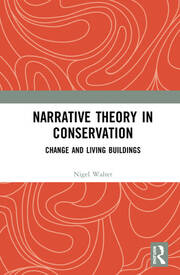
1st Edition
Narrative Theory in Conservation Change and Living Buildings
List of Figures
Preface and Acknowledgements
List of Abbreviations
1. Context: people and change in conservation
1.1 Beating the bounds: the scope of the argument
The question of living buildings
Fixity, fluidity and the problem of change
Buildings as people
Framing conservation as applied ethics
1.2 Conservation as ‘making’ and ‘keeping’
Conservation, preservation and monuments
Significance and values in the contemporary conservation framework
A new heritage paradigm?
1.3 Wider heritage concerns
Heritage studies
Agency and material vitality
1.4 Structure of the book
2. Modernity: conservation, discontinuity and the past
2.1 The development of conservation
Restoration
Reconstruction
2.2 Modernity and the past
2.3 But is it art? – non-aesthetic interpretation
Romantic and classical approaches to hermeneutics
Genius and authorship
2.4 Waking up to context
Cultural landscape and the palimpsest
Conclusion
Case Study: Carlo Scarpa, William Morris and the Castelvecchio, Verona
Background
Murphy on Morris
The instructive relic
Extending the narrative
3. People: community, language and power
3.1 Where are the people?
Experts, universalism and the local
Intangible heritage
The uses of intangibility
People and social value
Heritage as discourse
Community discourse
3.2 Living heritage
English parish churches
Conclusion
Case Study: St Alkmund, Duffield and the ecclesiastical exemption
Parish churches and the Faculty Jurisdiction system
The case of St Alkmund, Duffield
Critiquing the original judgment
Justification and enhancement
Theology and community
Conclusion
4. Tradition: change and continuity
4.1 Modernity, tradition and continuity
Tradition and conservatism
Tradition and the canon
4.2 Hermeneutics
Gadamer and tradition
The fusion of horizons
Understanding the other
4.3 Virtue ethics
MacIntyre’s contribution
The vitality of tradition
Conclusion
5. Narrative: time, history and what happens next
5.1 Temporality
History and transition
Double temporality
5.2 Narrativity
The nature of narrative
Identity
Community and the fitness of narrativity
5.3 The relevance of narrative for conservation
The central metaphor
Benefits of the narrative model
Conclusion
6. Application: the narrative approach to conservation
6.1 Questions of principle
Explanatory competition
The cultural whole
Continuity of character
Completed narratives
6.2 Questions of everyday practice
Significance
Reversibility
Expendability
Craftsmanship
6.3 Questions of meta-practice
‘Who need experts?’
People power
Difficult heritage
Restoration
6.4 Compatibility with tradition
Case Study: The SCARAB Manifesto
Context
The text of the Manifesto
Preamble
Ancient buildings exude LIFE
Ancient buildings expect CHANGE
Ancient buildings embody TRADITION
Ancient buildings form COMMUNITY
7. Conclusion: conservation ‘as if people mattered’
Conservation futures
History in the gap
Hybridity and the via media
Index
Biography
Nigel Walter is a Specialist Conservation Architect based in Cambridge, UK, a Fellow of the Royal Institute of British Architects, and a member of two ICOMOS International Scientific Committees. He specialises in living heritage, combining practice with research, and holds a PhD in conservation of historic buildings.
