





1st Edition
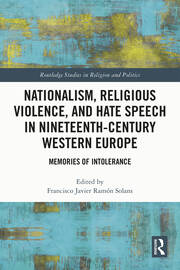
Nationalism, Religious Violence, and Hate Speech in Nineteenth-Century Western Europe Memories of Intolerance
Introduction
Francisco Javier Ramón Solans
1. Servetus’ Memory as the Symbol of Christian Intolerance
Valentine Zuber
2. Remembering and Narrating Catholic Intolerance in Anti-Catholic British Discourse during the Long Nineteenth Century
Géraldine Vaughan
3. A Battle for Freedom: The Statue of Giordano Bruno in Rome
Massimo Bucciantini
4. Manipulating Martyrdom: Repurposing the Victims of Blasphemy Prosecution for Libertarian Purposes in Nineteenth-Century England
David S. Nash
5. Between Perpetrator and Victim: Pedro Arbués’ Canonization and the Memory of Inquisition in 1867 Europe
Francisco Javier Ramón Solans
6. The “Legend” of Intolerant Spain in Nineteenth-Century Spanish Reactionary Discourse
Juan Pablo Domínguez
7. The Crusade Between Memorial Activation and Re-enactment: Sacrifice, War and the Brutalization of the Enemy in the Nineteenth Century
Ignazio Veca
8. Memories and Narratives of the Roman Inquisition in the First Half of the Nineteenth Century: Silences, Apologies, Denunciations
David Armando
9. The Reformation Re-enacted. The Role of the Sixteenth-Century Memory in the Swiss Kulturkampf
Sarah Scholl
10. Memory in Anti-Judaism and Modern Antisemitism: German Catholic Mentalities Between 1870 and 1945
Olaf Blaschke
11. Conclusion: Sites of Memory of Intolerance
Francisco Javier Ramón Solans
Index
Biography
Francisco Javier Ramón Solans is Ramón y Cajal Researcher at the University of Zaragoza, Spain. His current research is on Catholic politics of the past, religious nationalism, hate speech and the limits of religious freedom in nineteenth-century Europe.
“This timely and engaging volume sheds new light on how, in nineteenth-century Europe, memories of intolerance towards the religious ‘other’ got instrumentalised to carry out conflicts over faith-related issues in the contemporary world. Focused on cases of past religious violence, most of them from the early modern period, it will be of great interest to scholars of religion and memory in modern history.”
-Eveline G. Bouwers, Leibniz Institute of European History, Germany.
“This extraordinary collection of essays on the memory of religious intolerance in the Europe of the nineteenth-century nationalisms deepens our knowledge about the “invention of tradition”. Placing the case-studies in the general processes of that age - the multiplication of public commemorations, the explosion of cultural wars, the clash between secularisation and confessionalization - it explores the multifaced political uses of the religious in the construction of national identities.”
-Daniele Menozzi, Scuola Normale Superiore di Pisa, Italy.
“This illuminating collection is a landmark in the comparative history of religion and nationalism. Consolidated figures join forces with promising young scholars to explore the multilayered socio-cultural dimensions of religious intolerance in the crucial period between c. 1850 and 1945, as well as some infamously violent outbursts. The book breaks new ground in the study of Hebrew, Catholic and Protestant Europe, and thus constitutes a fine example of transnational historiography.”
-Gregorio Alonso, University of Leeds, United Kingdom.
