




1st Edition
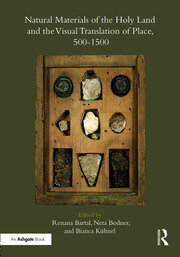
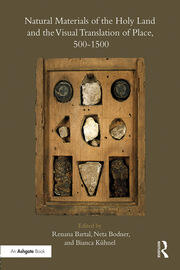
Natural Materials of the Holy Land and the Visual Translation of Place, 500-1500
Table of Contents
Foreword
Caroline Walker Bynum
Natural Materials, Place and Representation
Renana Bartal, Neta Bodner and Bianca Kühnel
I Collecting and Collections
1. Earth, Stone, Water and Oil: Objects of Veneration in Holy Land Travel Narratives
Ora Limor
2. Eleventh-Century Relic Collections and the Holy Land
Julia M. H. Smith
3. The Popes and the Loca Sancta of Jerusalem: Relic Practice and Relic Diplomacy in the Eastern Mediterranean after the Muslim Conquest
Manfred Luchterhandt
4. Jerusalem Refracted: Geographies of the True Cross in Late Antiquity
Laura Veneskey
II Agents of Translation
5. Una processione da farsi ogni anno con una messa solenne: Reception of Stone Relics from the Holy Land in Renaissance Ragusa
Tanja Trška
6. The Stone of Grace in the Gareja Desert, Georgia
Zaza Skhirtladze
7. Earth from Elsewhere: Burial in Terra Sancta beyond the Holy Land
Lucy Donkin
8. Materiality and Liminality: Nonmimetic Evocations of Jerusalem along the Venetian Sea Routes to the Holy Land
Michele Bacci
III Instillation and Enactment
9. Rocks of Jerusalem: Bringing the Holy Land Home
Elina Gertsman and Asa Simon Mittman
10. Image, Epigram, and Nature in Middle Byzantine Personal Devotion
Brad Hostetler
11. Place and Surface: Golgotha in Late Medieval Bruges
Nadine Mai
12. Moving Stones: On the Columns of the Dome of the Rock, Their History and Meaning
Lawrence Nees
13. Christ’s Unction and the Material Realization of a Stone in Jerusalem
Yamit Rachman-Schrire
IV Contemporary Re-enactment
14. Susan Hiller’s Homages to Joseph Beuys: Mystics, Cult and Anthropology
Kobi Ben-Meir
Biography
Renana Bartal (PhD, Hebrew University, 2010) is Senior Lecturer at the department of Art History, Tel Aviv University. She has co-edited Between Jerusalem and Europe: Essays in Honour of Bianca Kühnel (Leiden: Brill, 2015), and is the author of Gender, Piety and Production in Fourteenth Century Apocalypse Manuscripts (New York: Ashgate/Routledge, 2016).
Neta B. Bodner (PhD, Hebrew University, 2016) is a Post-PhD fellow in the ERC-funded project ‘Beyond the Elite: Jewish Daily Life in Medieval Europe’ at the Hebrew University of Jerusalem. Bodner teaches in the Art History department of the Hebrew University and at the Open University in Raanana. She has published several articles about Pisan monuments, and architectural translations of Jerusalem to Vienna and northern Italy.
Bianca Kühnel is Jack Cotton Professor Emerita of Fine Arts and Architecture at the Department of the History of Art, Hebrew University of Jerusalem. Her publications include From the Earthly to the Heavenly Jerusalem; Representations of the Holy City in Christian Art of the First Millennium (Rome-Freiburg/Br.-Vienna: Herder, 1987); The Real and Ideal Jerusalem in Jewish, Christian, and Islamic Art, Special Issue of Jewish Art 23/24, 1997/1998; and Visual Constructs of Jerusalem, ed. with G. Noga-Banai and H. Vorholt (Turnhout: Brepols Publishers, 2014).
