




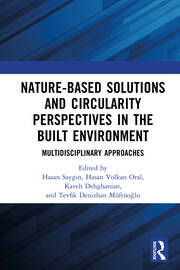
1st Edition
Nature-based Solutions and Circularity Perspectives in the Built Environment Multidisciplinary Approaches
Section 1: Energy Management in the Built Environment
Chapter 1: An Overview of Energy Use in The Built Environment and Its Importance: A Perspective on Architectural Design and Planning
Vassiliki T. G. Boulomytis, Natalie J. Barron, Cintia B. S. Dotto,Estella Baziotopoulos, Luciene Pimentel da Silva
Chapter 2: Auditing, modeling, and assessing energy infrastructure
Ramón Fernando Colmenares-Quintero, Luis Angel Guarin-García, Julián Andrés Mera-Pazb, Oscar Camilo Valderrama-Riverosc, Maria K. Kochaniecd,Tomasz Warężakef, Reyes María Lindao-Urianag.
Chapter 3: Implementing Nature-based Solutions (NbS) for Energy Efficiency, Water Management, Circularity, and Urban Resilience in the Built Environment
Amir Gholipour, Corentin Juin, Afsaneh Aghaei, Marcio Yukihiro Kohatsu, Jalal Azimi Amoli
Chapter 4: Nature-based and Circular Solutions for Water Management in the Built Environment
Gökhan Koçyiğit
Chapter 5: Resilient Urban Water Management with Nature-Based Solutions
Selma Koper, Dragan Milosevic
Section 2: Hydrology and Water Management Applications in the Built Environment
Chapter 6: Circular design in wastewater treatment from theory to implementation
Anna Grosser, Krzysztof Fijałkowski
Chapter 7: Coastal Cities and Nature-Based Solutions: A Synthesis of Theory and Practice
Dilara Büşra BARTAN, Merve SOYYİĞİT, Yaren ÖZTÜRK, and Derya AYRAL-ÇINAR
Chapter 8: Nature-Based Solutions for Water Resilience in Agricultural Landscapes
Carla S. S. Ferreira, Marijana K. Solomun, Milica Kašanin‑Grubin, Rares Halbac-Cotoara-Zamfir, Zahra Kalantari, António J. D. Ferreira, Matthew T. Harrison
Section 3: Application of Sustainable Natural Resources in Soil Improvement and the Built Environment
Chapter 9: Industrial Wastes for Soil Stabilization
Ehsan Etminan
Chapter 10: Sustainable Management and Remediation of PFAS in Soil with Insights from the Swedish Construction Sector
Ludvig Haiber, Adrian Kaso, Reza Ahmadi-Naghadeh
Biography
Hasan Saygın is a full engineering professor specializing in applied sciences (multidisciplinary and interdisciplinary studies). He earned his Ph.D. from École Polytechnique de Montréal, Institut de Génie Energétique at Université de Montréal, and his M.Sc. in Nuclear Energy from Istanbul Technical University, along with a B.Sc. in Mathematical Engineering from Yildiz Technical University. He is currently the Director of the Application and Research Center for Advanced Studies at Istanbul Aydin University and the Dean of the Faculty of Engineering.
Hasan Volkan Oral is a full-time researcher in the Department of Civil Engineering at the Faculty of Engineering, İstanbul Aydın University, Türkiye. After earning a Ph.D. from Boğaziçi University, he completed his postdoctoral studies at Ben Gurion University of the Negev, Israel, focusing on agricultural and environmental sciences. Currently, he is engaged in environmental sustainability, nature-based solutions (Nbs), and circularity applications within environmental science and engineering. He represents Turkey as a member of the Management Committee and leads Working Groups in various COST actions related to sustainability, NbS, and circularity. Dr. Oral is also the principal investigator of a TÜBİTAK (The Scientific and Technological Research Council of Turkey) and COST-funded research project that addresses circular water management applicable to nature-based solutions in the K. Menderes River Basin in Western Turkey.
Kaveh Dehghanian joined Istanbul Aydin University as a civil engineering faculty member in 2017 after earning a Ph.D. from Middle East Technical University in 2016. During his Ph.D. and master's research, he focused on “Estimation of Maximum Seismic Shear Strain in Imperforated Ground Excited by Vertically Propagating Shear Waves" and "The Equivalency Assessment of Geosynthetic Clay Liner (GCL) and Compacted Clay Liner (CCL) in an Engineered Landfill." His current research interests center on sustainable, environmentally friendly soil improvement methods, the use of materials, and the sustainable management of natural resources, as well as empirical correlations in soil mechanics and dynamics. He has participated in various COST action working groups related to sustainability and circularity.
Tevfik Denizhan MüftüoĞlu obtained his doctoral degree from the Department of Civil Engineering, Katip Celebi University of İzmir. His academic interests are mainly around the research of friction factor and pressure loss that occur in pipe flows, modeling of turbulent flows of Newtonian and non-Newtonian fluids in rough pipes, open-channel flows, artificial intelligence-based applications in hydraulics and hydrology, and sustainable water harvesting.
