




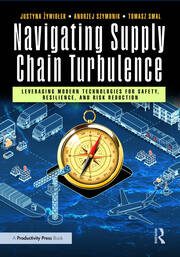
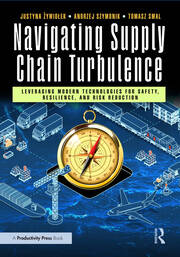
1st Edition
Navigating Supply Chain Turbulence Leveraging Modern Technologies for Safety, Resilience, and Risk Reduction
Preface
About the Authors
Introduction
1. Determinants of modern logistics
1.1. Conditions for the functioning of modern logistics
1.1.1 a case study in lcs under the covid-19 pandemic
1.1.2 a case study of lcs operations during the war in ukraine
1.2 development trends in modern logistics in the context of reducing risk and building resilient and safety lsc
1.3 conclusions
2. Management of modern supply chains
2.2 moving to digital and being flexible
2.3 selected management concepts used in logistics (e.g. Lean manufacturing and management, jit)
2.3.1 lean manufacturing and lean management in logistics
2.4 just-in-time (jit) in logistics
2.4. Sustainable supply chains
2.5 the function of digital technologies in sustainable supply chains
2.4. Trust and partnership management for supply chain needs
2.5. Comprehensive quality management in supply chains
2.6. Conclusions
3 security of supply chains
3.1 the essence and concept of supply chain security
3.1.1 security in the context of the supply chain
3.1.2 hazard characteristics
3.1.2.1 first approach
3.1.2.2 second approach
3.2. Supply chain determinants and indicators
3.2.1 monitoring operational performance
3.2.2 cost optimization
3.2.3 improving the quality of customer service
3.2.4 identification of areas for improving logistics processes
3.2.5 forecasting and planning
3.2.6 making strategic decisions
3.2.7 selected indicators supporting the assessment of supply chain security
3.2.7.1 on-time delivery (otd)
3.2.7.2 fill rate
3.2.7.3 inventory turnover
3.2.7.4 supply chain cost
3.2.7.5 perfect order rate (por)
3.2.7.6 days sales of inventory (dsi)
3.2.7.7 logistics costs as a percentage of sales
3.2.7.8 freight bill accuracy
3.2.7.9 supplier lead time
3.2.7.11 return rate
3.2.7.12 forecast accuracy
3.2.7.13 technicalizing the supply chain
3.2.7.13.1 summary supply chain security indicators
3.2.7.13.2 cybersecurity indicators in the supply chain
3.3. Analysis of selected cases
3.3.1 first example
3.3.2 second example
3.3.3 third example
3.3.4 fourth example
3.4 conclusions
4. Reliability, resilience and risk in lsc
4.1 the essence and concept of reliability, resilience and risk in supply chains
4.2 determinants and indicators of reliability, resilience and risk in supply chains and methods for their determination
4.2.1 reliability of lcs
4.1.1 resilience of lcs
4.2.2 risk management in lcs
4.3 analysis of selected cases
4.3.2 case study in the area of risk assessment
4.3.4 case study in area of resilience
4.4 conclusions
5. Future technologies in logistics supply chain management
5.1. An overview of the latest technologies used in supply chains
5.2. The impact of technology on the efficiency and security of supply chains
5.3. Analysis of selected cases
5.3.1 walmart's implementation of blockchain for food traceability
5.3.2 tradelens platform by maersk and ibm for shipping transparency
5.3.3 tesla's implementation of ai and iot for predictive maintenance and inventory optimisation
5.3.4 pfizer's cold chain management system for the distribution of covid-19 vaccines
5.3.5 amazon's automation of warehousing with robotics and artificial intelligence
5.4. Conclusions
6. Conclusions and recommendations on shaping safe and resilient lsc
6.1. Development and improvement of the efficiency, security and resilience of lsc
6.2. Modelling modern supply chains in a turbulent environment
Summary
References
Biography
Justyna Żywiołek, DSc. defended her doctoral dissertation with honors in the field of management science, specializing in security science, entitled: The Impact of Information Process Management on the Security of Knowledge Resources in the Enterprise, at the Faculty of Organization and Management of the Lodz University of Technology. Since January 2015, he has been working as an assistant professor at the Faculty of Management at the Technical University of Częstochowa. She is a respected researcher in Poland and abroad for his experience in management issues: knowledge and information management and their security. She has published over 160 articles and is the author/co-author/editor of seven books. She actively participated in presenting research results at various international conferences. He deals with data protection, is an inspector of personal data protection, and is a leading ISO 27001: 2018 auditor. Phd. Eng. Guest Editor of Energies MdPI, International Journal of Environmental Research and Public Health MdPI Journal, Computer Modeling in Engineering & Sciences. Early Career Editorial Board of The Journal of Strategic Information Systems IF 14.682 and Editorial Advisory Board of International Journal of Management and Applied Research IF 3.508. She participated in multiple Erasmus+ teacher mobility in Slovenia, Hungary, the Czech Republic, Slovakia, and France.
Andrzej Szymonik has the title of professor in social sciences and the degree of habilitated doctor in management sciences - which he obtained at the University of Warsaw. In 1972-2010, he performed military service, which he completed with the rank of brigadier general. He has extensive practical experience (over 25 years) in managing logistics in the domestic and foreign dimensions, considering threats and unplanned situations. He is the author and co-author of many books on logistics and security (details can be found at www.gen-prof.pl). He has similar achievements in published articles, the content of which is related to logistics, ecology, and security of supply chains. Currently, he works in the Supply Chain Management Department at the Lodz University of Technology, at the Faculty of Organization and Management.
Tomasz SMAL, DSc. graduated from the Military University of Technology in Warsaw and the University of Defense in the Czech Republic. He conducts scientific activities in the operation of weapon systems and management in logistics and transportation systems. He has conducted over 20 scientific projects; he is the author or co-author of over 100 articles and 10 monographs. He served as a professional soldier in the Polish Armed Forces logistics system. Then he conducted scientific and didactic activities in a military academy, where he was multi-awarded for scientific and military activities. Currently, he is a civilian professor at UWSB University in Wroclaw, where he researches the security and resilience of logistics systems. He participated in multiple Erasmus+ teacher mobility in the Czech Republic, Slovakia, Italy, Bulgaria, Portugal, and Greece.
