





1st Edition
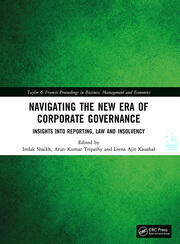
Navigating the New Era of Corporate Governance Insights into Reporting, Law and Insolvency
Part 1: Corporate Governance & Board Dynamics
1. Examining the Nexus Between Board Gender Diversity, Ownership Patterns, and CEO Remuneration: Evidence from India
Dr. Sumita Shroff, Dr. Priyanka Panday
2. Board Gender Diversity and Credit Risk: An Exploratory Systematic Literature Review Using the TCCM Framework
Charu Kaistha
3. Influence of Independent Directors on Firm Risk: Evidence from Advanced Economies
Dr. Souvik Banerjee, Shalini Aggarwal
4. AI-Enabled Employee Monitoring: Role of Corporate Governance in Human Capital Management
Prof. Priyanka Vallabh
5. Ethical Leadership in Business: Role in Fostering Integrity and Corporate Governance
Dr. Madhuri Gehi, Dr. Vivek Singh Kushwaha, Dr. Ritu Mishra, Dr. Gunja Thakur, Dr. Priyanka Yadav
6. The boardroom in the era of Artificial Intelligence
Lin Jiang
Part 2: ESG & Sustainability
7. Corporate Social Irresponsibility: A Case Study of Pepsi Co. Supplier in India
Nidhi Srivastava
8. Balancing Workforce Reskilling and Automation: AI Adoption and Social Sustainability in Service Industries
Dr. Khagendra Nath Gangai, Rachna Agrawal
9. Greenwashing and the Ethics of Sustainability Communication: Measurement, Drivers, and Stakeholder Consequences
Prof. Vidhu Gaur
10. Institutional Governance and Stakeholder Collaboration of Corporate-Vocational Education Partnerships towards Sustainable Skill Development in India
Ranjini S. Nadig, Dr Tanu Shukla, Prof. Virendra Singh Nirban
11. Unlocking Sustainability Gates: Structural Pathways for Sustainable HRM Practices.
Amita Yadav, Prof. Ashutosh Nigam
12. From Policy to Practice: Challenges in Implementing Sustainability in Banking
Gayatri Mayee, Shishir Kumar Mishra, Bhargavi Karamcheti, Prof. Arunima Haldar
13. Sustainability Reporting in the Context of the Growing Importance of Corporate Governance in Organizations
Ira Acharya, Prof. Neera Jain, Prof. Imlak Shaikh
14. Regulatory Divergence and ESG Alignment: Comparative Assessment of Sustainability Disclosures
Dr. Sherry Abdellatif, Dr. Valdir Filipe, Rehna Haneef
Part 3: Financial Risk & Market Dynamics
15. Firm Financial Performance and Macroeconomic Aggregates Under a Progressive Floating Exchange Rate
MOUTAIB Nouhaila, LAHRICHI Younès
16. Influence of Government Policies & external factors on the intention to invest in financial instruments
Prof. Amit Kumar Gupta
17. Liquidity Risk Management in Islamic Banks in Emerging Markets: An empirical study
SARA MIKOU, Younes Lahrichi, Said Achchab ENSIAS
18. Mapping the Financial Risk Topography of Indian Industries: A Data-Driven Clustering Approach
Krishnika Yadav, Dr. Saurabh Chadha
19. Do Nonverbal Signals Affect Firm’s Financial Performance?
Aaditya Sawant, Prof. Arunima Haldar
20. Heterogeneous Effects of Irrational Sentiment on Global Equity Market Returns
Jitender Soni, Dr Pramod Kumar Naik
21. Analysing the Impact of Monetary Policy on Stock Market Volatility
Ravi M Luhar, Prof. Prashant Vadikar
22. Overview of Corporate Resilience in India: Sectoral Recovery Trends After COVID-19
Radhika Yadav, Dr. Satyendra Kumar Sharma
Part 4: Digital Innovation & AI
23. Triple Entry Accounting: A Novel Decentralized Reporting and Governance Approach
Nishant Sapra, Jyoti Dua
24. From Algorithms to Judgment- Artificial Intelligence in Corporate Fraud Detection
Saurabh Mehta, Prof. Arunima Haldar
25. Investigating the commercial bank’s digital paradox in emerging markets
Anas AZZABI, Younès LAHRICHI
26. Consumer Behavior in the Digital Age: Insights, Influences, and Ethical Decision-Making
Prof. Vidhu Gaur
27. Strategic Roadmap for Cloud-Native Finance: A Fuzzy DEMATEL Analysis of Key Drivers
Prof. Anil Misra, Prof. Manoj K Srivastava
Part 5: Law, Policy & Regulatory Compliance
28. Navigating Insolvency: Insights from India’s Insolvency Professionals
Shefali Sethi
29. Legal Framework for Critical Components of Cyber Risk: A Comparative Analysis
Dr. Ashu Tiwari
30. BUSINESS JUDGEMENT RULE: how Indian Judiciary sets the boundaries?
Dr. Anindita Jaiswal Jaishiv
31. How organizations adapt to regulatory frameworks and respond to global standards
Sharad Singh, Prof. Ruchi Agarwal
32. Regulatory Compliance Failure and Governance Breakdown in Indian Civil Aviation
Leena Ajit Kaushal
33. Market Reactions to SEBI’s Regulatory Reforms: An Event Study
Mishra Tirathkumar M, Prof. Prashant Vadikar
34. Systematic Literature Review on Insolvency and Bankruptcy Code
Nirali Kantharia, Dr. Jivan Biradar
35. BluSmart’s Green Promises, Grey Realities: When ESG Narratives Meet Governance Gaps
Prof. Arun Kumar Tripathy, Prof. Nidhi S Bisht
Biography
Imlak Shaikh is an accomplished academic and researcher in Accounting and Finance, currently serving as Professor at the Management Development Institute (MDI), Gurgaon, India. He served as the Chairperson of the School of Management of Financial Institutions (SoMFI) and Warden (Boys’ Hostel) at MDI Gurgaon. He holds a Ph.D. in Finance from the Indian Institute of Technology (IIT) Bombay, where his doctoral research on implied volatility in the Indian derivatives market earned him the prestigious Ph.D. Thesis Excellence Award at IIT Bombay’s 53rd Convocation. Prof. Shaikh also holds an MBA (Banking & Finance), M.Phil. (Banking), M.Com., and B.Com. with specialization in Statistics, and is a Gold Medallist in M.Com. He has qualified UGC-NET and JRF in both Commerce and Management.
Arun Kumar Tripathy is a Fellow from Indian Institute of Management (IIM), Bangalore, with specialization in the field of Corporate Strategy and Policy. He is currently a faculty in the area of Strategic Management at MDI Gurgaon. His current research focus is on corporate governance and sustainability, with an emphasis on their strategic implications for organizations. His research work has been published in high-impact journals. One of the business cases that he has authored was nominated for the Outstanding Case Author award. In addition, he has presented his research at various national and international conferences. He has also served as an Independent Director on the boards of several Indian companies, where he contributed to key board-level committees such as the Audit and Risk Management Committee and the Nomination and Remuneration Committee. He has been a visiting faculty member at several Indian Institutes of Management (IIMs). Prior to entering academia, he held various industry roles, including consultant, head of strategy, and marine engineer.
Leena Ajit Kaushal is faculty in Economics at Management Development Institute Gurgaon, India. She did her PhD in Economics and Masters in Business Economics (MBE) from Devi Ahilya University, India. She has received Postgraduate Certificate in Academic Practice from Centre for the Enhancement of Learning and Teaching (CELT), Lancaster University, UK and holds a status of ‘Associate of United Kingdom Higher Education Academy’. Her teaching areas are Macro Economics, Development Economics, International Economics and Foreign Direct Investments. She has authored and co-authored quite a few books. She is credited with research publications and case studies in various refereed national and international journals. Her research interest lies in the field of Development Economics, Foreign Direct Investment, Sharing economy and Macroeconomic issues and policies.
