




1st Edition
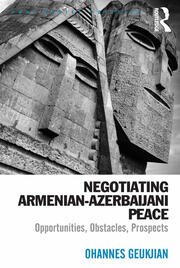
Negotiating Armenian-Azerbaijani Peace Opportunities, Obstacles, Prospects
By Ohannes Geukjian
Copyright 2014
300 Pages
by
Routledge
300 Pages
by
Routledge
Also available as eBook on:
Conflict resolution, conflict management and conflict transformations are major themes in this unique book which examines, explores and analyses the mediation attempts of the Organization for Security and Cooperation in Europe in the Nagorno-Karabakh conflict. Ohannes Geukjian shows the most striking characteristic of a protracted internal conflict such as this is its asymmetry and explains that,... Read more
1: Introduction, Approaches, Methodology and Structure; 2: Conceptual Framework; 3: Peacemaking or Managing Ethnic Conflict? (1991-93); 4: Renewed Dynamics of International Efforts to Make Peace (1994-97); 5: Potential Options for Peace (1998-2000); 6: Bilateral Negotiations Between Armenia and Azerbaijan (2001-06); 7: Trying to Get a Breakthrough (2007-12); 8: Obstacles to Peace and Prospects for Conflict Resolution; Conclusion; Epilogue
Biography
Ohannes Geukjian is a Lecturer in the Political Science and Public Administration Department at the American University of Beirut.
’Employing a powerful theoretical apparatus with deep local knowledge, Ohannes Geukjian gives us a firmly-grounded analysis of a seemingly intractable conflict - the deadlocked contest of Armenia and Azerbaijan over Nagorno-Karabakh. This asymmetrical struggle over a treasured piece of the "national" territory has frustrated state leaders and international mediators. Geukjian demonstrates that resolution of the conflict requires recognition of the security needs of the two sides, reduction of the mutual perceptions of threat, and consideration of the identity issues of both sides. Where mediators have failed, locals and track two diplomacy might offer a way forward. This is a novel, hopeful alternative to what has not worked up to now.’ Ronald Grigor Suny, The University of Michigan, USA ’An astute and balanced analysis of the continued inability of the Armenians and Azerbaijanis to solve their conflict over the disputed territory of Nagorno-Karabakh. Geukjian provides an excellent theoretical introduction for his analysis, offers some peace-making suggestions of his own, and highlights the often obstructive roles of Russia and Turkey in the peacemaking process.’ Robert O. Freedman, Johns Hopkins University, USA 'Negotiating Armenian-Azerbaijani Peace is a valuable contribution to the literature on conflicts, frozen and otherwise, in the former Soviet Union. It is also a worthwhile read for students and practitioners of conflict management and resolution, particularly those in which territory; ethnicity; and identity are relevant factors.' The Military Review
