




1st Edition
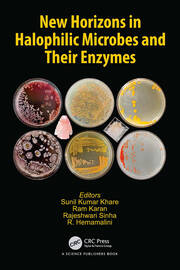
New Horizons in Halophilic Microbes and Their Enzymes
Preface
Halophilic Microbes and Enzymes: Diversity, Adaptation, Bioprospecting, and Biotechnological Potential
Shubham Pandey, Bhavna Parmar, Sumit Kumar, Siddaraju M. Nanjundaiah, Alvin Huang and Ram Karan
Halophilic Microbial Communities and Biodeterioration of Cultural Heritage
Mehrnoosh Rasooli, Atefeh Safarpour and Mohammad Ali Amoozegar
Metagenome-Assembled Genomes of Prokaryotic Halophiles
Kian Mau Goh, Frazer Midot and Rajesh K. Sani
Update on the Regulation of Nitrogen Assimilation in Haloarchaea
Basilio Zafrilla, Laura Matarredona, Mónica Camacho, Julia Esclapez and María-José Bonete
Heterologous Expression Systems for the Production of Commercially Important Enzymes From Halophiles
Hasti Ramavat, Ankita Dobariya, Ramesh Kothari and Satya P. Singh
Halozymes From Haloarchaea and Their Industrial Significance
Vijay Kumar and Santosh Kumar Tiwari
Plant Polymer Degrading Extremozymes From Halophilic Bacteria: Their Present State and Future Prospects
Sanket Gaonkar and Sunita Borkar
Potential of Domestic Waste for the Growth and Production of Enzymes in Halophiles
Ankita Dobariya, Hasti Ramavat, Hina Radadiya, Gira Mankad, Ramesh K. Kothari and Satya P. Singh
Synthesis of Polyhydroxyalkanoates by Halophilic Bacteria and Archaea
Joephil D. Dias, Asbern J. F. D’Silva and Judith M. Braganca
Polyhydroxyalkanoate Synthesis in Halotolerant and Halophilic Members of the Halomonadaceae Family
Andreea-Melisa Tripon, Doriana-Mădălina Buda, Horia Leonard Banciu and Adorján Cristea
Application of Halophiles and Halotolerant Microbes in Industrial Wastewater Treatment
Anuja Kalra, Gunisha Wadhawan, Sumit Kumar and Anshu Gupta
Microbial Bioprocess Efficiency Improvement Through Artificial Intelligence and Machine Learning (AI-ML) Tools
Mandeep Dixit, Guddu Kumar Gupta, Dharini Pandey, Reeta Kumari, Deepak Chhabra, Naveen Kango and Pratyoosh Shukla
Index
Biography
Sunil Kumar Khare is Director of IISER Kolkata and former Dean (R&D) and Chair Professor at IIT Delhi. His research focuses on extremophiles, extremozymes, and biocatalysis for sustainable bioprocesses. He has published over 230 papers, holds patents with h-index 54, and has deposited novel halophiles. A fellow of FRSC, FNAAS, FBRS, and FAMSI, he serves as Associate Editor for reputed journals including 3 Biotech and BMC Biotechnology and is Vice President of BRSI and President-Elect of the Association of Microbiologists of India.
Ram Karan is Associate Professor of Microbiology at the University of Delhi South Campus. He received his Ph.D. from IIT Delhi and has held research positions in the USA and Saudi Arabia, including at the University of Maryland, USUHS, and KAUST. His research focuses on extremophiles, extremozymes, and microbial biotechnology with applications in bioenergy, bioremediation, and sustainable industries. He is a recipient of several international awards and serves on the editorial boards of reputed journals.
Rajeshwari Sinha received Ph.D. from IIT Delhi in 2015, where her work focused on halophilic bacterial toxicity and biocatalysis aspects of nanoparticles. She has since been working at the science-policy interface in the health space. As an independent researcher, she uses scientific training to synthesize knowledge and develop solutions on issues impacting human health. She has published her work in reputed journals, and also writes in media platforms. Dr. Sinha is also an alumna of IIM Calcutta.
R. Hemamalini is a Life Sciences researcher with a focus on extremophiles and their potential in addressing environmental challenges. She actively contributes to academic and public science platforms through journal articles, book chapters, and popular science writing. Her work emphasizes research outreach, science communication, and technology commercialization. Committed to bridging science and society, she strives to make research accessible, relevant, and impactful across disciplines and for diverse communities.
