




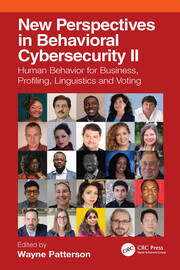
1st Edition
New Perspectives in Behavioral Cybersecurity II Human Behavior for Business, Profiling, Linguistics and Voting
Section I: Perspectives on Behavioral Science Approaches to Cybersecurity
1. Integrating Behavioral Sciences and Deep Learning in Network Behavior Analysis for Threat Detection.
Ariel Isaac Posada Barrera, Laura Margarita Rodríguez Peralta, and Erick Rosete Beas
2. Cognition-Inspired Design in Mind: Demonstrations in Graphical Authentication.
Jeremiah D. Still and Mary L. Still
3. Cybersecurity Defense: Against Pro or Amateur Attackers.
Wayne Patterson
Section II: Perspectives on Business Approaches in Cybersecurity
4. Hybrid Intelligence in Cybersecurity Banking.
Tihomir Dovramadjiev, Rusko Filchev, and Rozalina Dimova
5. Efficient Intrusion Tolerant System Based on Machine Learning and Human Behavior.
Michael Ekonde Sone, Ann N. Amah, and Badrouzamani Mana
Section III: Perspectives on Profiling Approaches to Cybersecurity
6. Personality Profiles of Cyber Criminals: An Integration of Existing Research.
Tova Lane
7. Cybersecurity Is Not on Maslow's Hierarchy: Implications of the Difference between Users' Physical Security and Cybersecurity Attitudes and Behaviors.
Aryn Pyke
Section IV: Perspectives on Linguistic Approaches to Cybersecurity
8. Using Language Translation Software to Detect and Classify Cyberattacks.
Wayne Patterson, Carlos Azzoni, Diana Florea, Kaido Kikkas, Birgy Lorenz, Rosangela Malachias, Leonid Vagulin, and William Emmanuel S. Yu
9. Isolating Key Phrases to Identify Ransomware Attackers.
Jeremy Blackstone
Section V: Perspectives on Voting Approaches to Cybersecurity
10. Protecting Democracy in an Increasing Digital World: A Philippine e-Voting Story.
William Emmanuel S. Yu
11. Passwords: An Empirical Study of Behaviors in the Social Media Era.
Augustine Orgah, Sneha Sudhakaran, and Dyaisha Orgah
Biography
Wayne Patterson is a retired as a professor of computer science at Howard University. In 1993, he was appointed Vice President for Research and Professional and Community Services, and Dean of the Graduate School at the College of Charleston, South Carolina. His other service to the graduate community in the United States has included being elected to the Presidency of the Conference of Southern Graduate Schools, and also to the Board of Directors of the Council of Graduate Schools. Dr. Patterson has published more than 50 scholarly articles primarily related to cybersecurity, one of the earliest textbooks in cybersecurity, Mathematical Cryptology (1986), and recently New Perspectives in Behavioral Cybersecurity (CRC Press, 2024).
He received degrees from the University of Toronto (BSc and MSc in ,athematics), University of New Brunswick (MSc in computer science), and the University of Michigan (PhD in mathematics). He also held Post-Doctoral appointments at Princeton University and the University of California - Berkeley. He has recently been honored to have been named to the "Hall of Honour" at his undergraduate University, St. Francis Xavier University in Nova Scotia, Canada, and also by having a Graduate Fellowship named after him at the College of Charleston, in recognition of his being the Founding Dean of the Graduate School there.
“This new volume of New Perspectives in Behavioral Cybersecurity continues in the footsteps of its predecessor by addressing an important aspect of cybersecurity that’s often underrepresented—the human factor. Technical cybersecurity, the arena where complex malware is reverse-engineered and sophisticated monitoring systems thwart cyber attacks, is crucially important. But human factors, which don’t get as much airplay, are equally critical in defending computer systems, because most costs related to cyber attacks are the direct result of human error.” -- Golden George Richard III, Professor of Computer Science, Louisiana State University
