




1st Edition
No Bicycle, No Bus, No Job The Making of Workers’ Mobility in the Netherlands, 1920-1990
By Patrick Bek
Copyright 2022
212 Pages
by
Routledge
212 Pages
by
Routledge
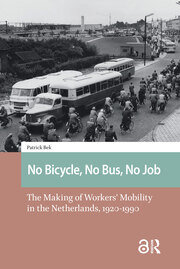
For working people, the cost of getting to work, in terms of time and expense, is a crucial aspect of daily life. In the twentieth century, people’s opportunity to travel increased. This did not, however, apply to everyone. The absence of affordable housing near job locations combined with the lack of safe, efficient, and affordable mobility options aggravated social exclusion for some. No... Read more
Acknowledgements, Figures, Introduction, How Workers' Travel was Controlled in Many Ways, Mobility in Key Dutch Industrial Centers, Grasping the Worker's Perspective of Mobility, 1 Responding to the Transport Mismatch, 1920-1940, 2 Protesting Bus Regulations during the Depression, 1926-1938, 3 Mobility Austerity during War and Scarcity, 1940-1947, 4 Mobility Barriers during Postwar Industrialization, 1947-1970, 5 Postwar Mobility Practices, 1947-1970, 6 Disciplining Cyclists and Moped Riders, 7 Mobilizing Rural and Migrant Workers by Company Bus, 8 Leaving Workers to their Own Devices during Deindustrialization, 1970-1990, Conclusion, Bibliography, Archival Collections, Online Collections, Newspaper and Journal Articles, Published Documentation of Government and Non-Governmental Organizations, Scholarly Publications, Index
Biography
Patrick Bek is a historian who received his PhD in 2021 from Eindhoven University of Technology. His research interests include labor history, history of technology, and mobility studies. He currently lectures at Rotterdam University of Applied Sciences.
