





1st Edition
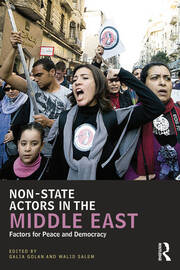
Non-State Actors in the Middle East Factors for Peace and Democracy
Biography
Galia Golan is a leading Israeli political scientist, formerly head of the Political Science Department at the Hebrew University, Jerusalem, currently Head of the M.A. and Conflict Resolution Programs at the Interdisciplinary Center, Herzliya (IDC) and the author of ten books, most recently on the Arab-Israeli conflict, Israel and Palestine: Peace Plans and Proposals from Oslo to Disengagement (second edition 2007); presently working on Breakthroughs and Failures in Israeli Peace-making Since 1967.
Walid Salem is the director of Panorama, the Palestinian Center for the Dissemination of Democracy and Community Development in Palestine.
Galia Goran and Walid Salem […] have succeeded in putting together a series of articles that comprehensively analyse the current developments in the region, the reasons underlying these changes and the potential consequences they might engender in the region. It deals with the role of non-state actors in this political environment and how they get engaged in efforts for further democratisation, peaceful transition as well as equal citizenship. […] What makes the book unique is perhaps the fact that all the authors who contributed to this volume are from the region or they have been directly involved with these topics for a long time. They manage to bring first-hand knowledge to the literature and provide original accounts of events that might be missing in other scholarly works. […] this volume provides an excellent snapshot of the current situation to the reader. The authors do not engage with theoretical debates related to their field and do not aim to contribute to a theory building effort in terms of understanding the role of non-state actors in today’s world. Rather, each chapter provides rich empirical data, which constitutes a toolbox for other scholars who plan to undertake that endeavour. The book is very informative and makes us understand that non-traditional actors are players in the game of politics all around the world, as in the MENA region, and their interests are also at stake. The book is highly recommended to those who want to learn more about the current developments, opportunities and challenges in the region.
Bahar Başer, Coventry University, UK
Kurdish Studies Journal
