



2nd Edition
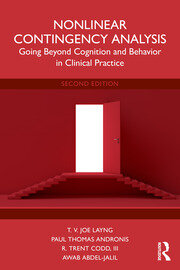
Nonlinear Contingency Analysis Going Beyond Cognition and Behavior in Clinical Practice
1. Our Purpose 2. Fundamentals of Consequential Contingency Analysis 3. What is a Consequential Contingency? 4. What Does It Mean to be Constructional? 5. NCA as a Constructional Approach 6. Within the NCA Session 7. NCA and Patterns Arising from Organic or Medical Issues 8. Distinguishing Between NCA and Other Approaches 9. Measuring NCA Outcomes: Avoiding Response Bias 10. NCA: Distinguishing Between Apparent and Genuine Consent and Assent 11. Topical and Systemic NCA Interventions: A Case Study
Biography
T. V. Joe Layng, PhD, a pioneering behavior scientist, has dedicated over five decades to research, clinical innovation, and educational technology applications, significantly advancing nonlinear contingency analysis and the constructional approach.
Paul Thomas Andronis, PhD, is a leading experimental behavior analyst whose landmark discovery of contingency adduction and decades of academic leadership shaped modern behavioral science and its applied impact.
R. Trent Codd III, EdS, BCBA, is a clinician-scholar integrating behavior analysis and cognitive-behavioral therapy. He has extensive experience in clinical practice, training, supervision, and authorship.
Awab Abdel-Jalil, PhD, BCBA, is an applied researcher at Upstate Caring Partners, and an educator with scholarship/presentations on nonlinear contingency analysis, constructional approaches, and assent-based interventions.
“The second edition of this book amplifies the benefits of the first for clinicians who wish to expand their toolbox in work with complex and refractory patients. The authors retain the chapters that describe the theoretical principles behind the approach and provide vivid clinical descriptions that bring them to life. Equally impressive are additions about the usefulness of this approach in neurodevelopmental disorders, constructional exposure therapy, and the ethical principles that underlie assent and consent to behavioral treatments. If you think of behaviorism as mechanistic and cold, the person-centered, values-based principles contained here will change your view.”
Donna M. Sudak, MD, AADPRT, professor of psychiatry and vice chair for education at Drexel University
“Layng and colleagues offer a clear introduction to constructional exposure therapy and the building of new repertoires while respecting client needs. A chapter on consent, assent, and freedom provides a behavior-analytic treatment of genuine participation involving verbal and nonverbal individuals, including animals. This essential and engaging read, along with its companion volume Case Studies and Applications in Nonlinear Contingency Analysis, strengthen ethical practice and expand the analytic core of behavior analysis.”
Janet S. Twyman, PhD, BCBA-D, LBA-NY, founder and chief learning scientist at blast!
“This book revolutionized my work with a diverse array of animal learners. It offers a vital framework for optimizing animal well-being, reaching desired goals, and solving complex challenges where traditional methods fail. It’s a permanent fixture on my recommended reading list for professionals.”
Barbara Heidenreich, zoologist and international animal behavior consultant
