
1st Edition

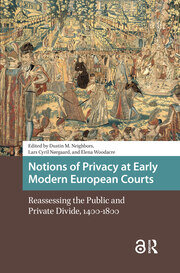
Notions of Privacy at Early Modern European Courts Reassessing the Public and Private Divide, 1400-1800

304 Pages
by Routledge

304 Pages
by Routledge

Grand, extravagant, magnificent, scandalous, corrupt, political, personal, fractious; these are terms often associated with the medieval and early modern courts. Moreover, the court constituted a forceful nexus in the social world, which was central to the legitimacy and authority of rulership. As such, courts shaped European politics and culture: architecture, art, fashion, patronage, and... Read more
List of Illustrations, List of Contributors, Acknowledgements, Reassessing the Public/Private Nature of European Court Cultures: An Introduction, Theories and Conceptions of Courts, Chapter 1: Considering Privacy at Court, Chapter 2: Privacy at Court? Reconsidering the Public/Private Dichotomy, Chapter 3: The Monarch Exposed: The Negotiation of Privacy at the Early Modern Court, Architecture, Spaces and Access, Chapter 4: Institutionalised Privacy?—The Need to Achieve and Defend Privacy in the Frauenzimmer, Chapter 5: Public Displays of Affection: Creating Spheres of Apparent Royal Intimacy in Public, Chapter 6: The Translation of Court Culture from the Burgundian Court to the Kingdom of Castile: The Sovereign's Privacy and Relationship with Court Artists, Chapter 7: On Privacy—or Rather the Lack Thereof—at Court in the Polish Literature of the Sixteenth Century, Religion, Chapter 8: 'Au Milieu d'une Cour Superbe & Tumultueuse': Devotional privacy at the Court of Versailles, Chapter 9: Private Justice or Ducal Power? Testing the Strength of Public Authority and Dynastic Loyalty by Trans-national Nobles at the Court of the Duke of Lorraine, Chapter 10: The Politics of Privacy: Examining Influence and Personal Relationships at the English and Holy Roman Imperial Court, Index

Biography

Dustin M. Neighbors is the project coordinator and a postdoctoral researcher for the EU-Horizon funded project, Colour4CRAFTS at the University of Helsinki. His main area of research is on monarchy and court culture, with an emphasis on the performativity of gender, political and material culture, cultural practices and history (i.e., hunting) within sixteenth and seventeenth-century Northern Europe, and the employment of digital research methods. Lars Cyril Nørgaard is Assistant Professor at the Centre for Privacy Studies at the University of Copenhagen. He was awarded an international postdoctoral fellowship from the Independent Research Foundation Denmark. His research interests include but are not limited to the tension between religious seclusion and societal engagement, the relationship between manuscript text, print, paratext and image, and the ambiguous nature of premodern privacy. Elena Woodacre is Reader in Renaissance History at the University of Winchester. She is a specialist in queenship and royal studies and has published extensively in this area. She is the editor-in-chief of the Royal Studies Journal and two book series with Routledge and ARC Humanities Press. Her most recent monographs include a biography of Joan of Navarre (2022) and Queens and Queenship (2021).
