




1st Edition
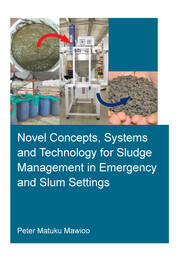
Novel Concepts, Systems and Technology for Sludge Management in Emergency and Slum Settings
Chapter 1 Introduction
1.1 General introduction
1.2 Sanitation in emergency situations
1.3 Challenges in emergency faecal sludge management and the need for alternative technology options
1.4 Aim and scope of the thesis
1.5 Research hypotheses
1.6 Objectives
1.7 Outline
References
Chapter 2 Emergency sanitation: A review of potential technologies and selection criteria
Abstract
2.1 Introduction
2.2 Challenges in emergency sanitation
2.3 Sanitation options for faecal sludge and wastewater disposal in emergencies
2.4 Selection of sanitation technologies in emergency response
2.5 Conclusions and recommendations
References
Chapter 3 Innovative approaches to emergency sanitation: The concept of the emergency sanitation operation system - eSOS®
Abstract
3.1 Introduction
3.2 eSOS®
3.3 eSOS® kit
3.4 eSOS® smart toilets
3.5 Intelligent faecal sludge collection vehicles tracking system
3.6 Faecal sludge treatment facility
3.7 Emergency sanitation coordination centre
3.8 eSOS® operation
3.9 Costs and eSOS business model
3.10 Concluding remarks
Acknowledgments
References
Chapter 4 Microwave technology as a viable sanitation technology option for sludge treatment
4.1 The microwave technology
4.2 Microwave heating system
4.3 Principles of microwave technology
4.4 Mechanisms of microwave heating
4.5 State of art of microwave application in waste treatment
4.6 Conclusions and recommendations
References
Chapter 5 Evaluation of a microwave based reactor for the treatment of blackwater sludge
Abstract
5.1 Introduction
5.2 Materials and methods
5.3 Results
5.4 Discussion
5.5 Conclusions and recommendations
Acknowledgments
References
Chapter 6 Microwave treatment of faecal sludge from intensively used toilets in the slums of Nairobi, Kenya
Abstract
6.1 Introduction
6.2 Materials and methods
6.3 Results
6.4 Discussion
6.5 Conclusions and recommendations
Acknowledgments
References
Chapter 7 Design, development and evaluation of a pilot-scale microwave based technology for sludge sanitization and drying
Abstract
7.1 Introduction
7.2 The concept
7.3 Research approach
7.4 Validation, design, development and production
7.5 Preliminary experimental tests and improvements
7.6 Evaluation of pilot-scale microwave reactor unit version 3
7.7 Materials and methods
7.8 Results and discussion
7.9 Conclusions
Acknowledgments
References
Chapter 8 Conclusions and outlook
8.1 Conclusions
8.2 General outlook
References
Biography
Peter Matuku Mawioo, a Sanitary Engineer, was born in 1979 in Kitui County, Kenya. He obtained his MSc. in Municipal Water and Infrastructure; specialization in Sanitary Engineering from IHE Delft Institute for Water Education, Delft, the Netherlands in 2010. Peter obtained his BSc degree from the Department of Civil and Environmental Engineering; specialization in Water and Environmental Engineering from Egerton University, Kenya in 2006. He is currently employed as a Lecturer in Public Health Engineering in the Department of Civil and Structural Engineering at the University of Eldoret (UoE), Kenya. Peter carried out his PhD studies in Sanitary Engineering at Delft University of Technology, Delft and IHE Delft Institute for Water Education, Delft, The Netherlands between 2011 and 2017. His PhD research topic focusses on the development and improvement of sanitation technologies for application in isolated cases such as the slum, emergency, and similar situations. Peter’s research interests include biological wastewater treatment, membrane bioreactors, wastewater reuse, non-sewered sanitation, and innovative scientific environmental technologies.
