
1st Edition

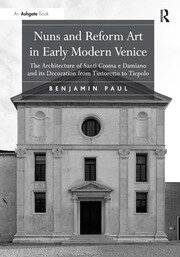
Nuns and Reform Art in Early Modern Venice The Architecture of Santi Cosma e Damiano and its Decoration from Tintoretto to Tiepolo

By Benjamin Paul Copyright 2012
334 Pages
by Routledge

344 Pages
by Routledge

Decorated by Giovanni Buonconsiglio, Jacopo Tintoretto, Palma il Giovane, Sebastiano Ricci and Giambattista Tiepolo, the church of the former Benedictine female monastery Santi Cosma e Damiano occupies an outstanding position in Venice. The author of this study argues that from its foundation in 1481 to its dissolution in 1805, Santi Cosma e Damiano was a reform convent, and that its nuns employed... Read more
Contents: Introduction; Part I The Convent of Santi Cosma e Damiano: Its History and Architecture: The beginnings of the nunnery and its first church; The new convent and church; The architecture of the new convent and church; Santi Cosma e Damiano's sister churches and their design; Cassinese reform architecture. Part II The Decoration of Santi Cosma e Damiano: The altarpieces; Tintoretto's Crucifixion and Cassinese spirituality; Tintoretto's Santi Cosma e Damiano altarpiece; The 16th-century frescoes; Later decoration and the covenant with God; Conclusion; Appendices; Bibliography; Index.

Biography

Benjamin Paul is an Assistant Professor of Art History at Rutgers, The State University of New Jersey, USA.

'... beautifully produced book...' Renaissance Quarterly

'Through his careful analyses of the paintings that once decorated the church, Paul attempts to reconstruct its sixteenth-century appearance. His discussions of the canvases by Jacopo Tintoretto are exemplary: the Crucifixion (now in the parish church of Selva di Montello, province of Treviso) is considered in the light of the Cassinese Congregation’s tenet, in particular its Pauline theology of the Cross. For Tintoretto’s high altarpiece of the Virgin and Child in glory with saints (Gallerie dell’Accademia, Venice), Paul establishes a fascinating link between the Apocalyptic Woman, the massive dark clouds that support her and several of the saints, and the plague that struck Venice in 1575-77.' The Burlington Magazine
