




1st Edition
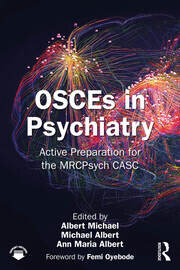
OSCEs in Psychiatry Active Preparation for the MRCPsych CASC
1. Introduction
Albert Michael
Part 1: Psychopathology
2. Hallucinations
John Mathai Panickacheril
3. Delusions
Nandini Chakraborty
4. Dissociative symptoms
R. Raguram
Part 2: Neuropsychiatry
5. Cognitive function
Michael Albert
6. Insomnia
Bruna Sanader Vukadinovic
7. Sleep attacks
Shekar Raman
8. Cerebellum
Michael Albert
9. Frontal lobe
Michael Albert
10. Parietal lobe
Michael Albert
11. Complex partial seizures
Ann Maria Albert and Michael Albert
Part 3: Perinatal
12. Regular mood swings
Jane Still
13. Menopausal syndrome vs depression
J Kulkarni
14. Unwell new mother: Assess
Rebecca Dickenson
15. Postpartum Psychosis: Explain
Naashoma Pereira Carvalho and Irma Beyers
Part 4: Child and adolescent
16. Child ADHD: Collateral history
Ananta Dave
17. School refusal: Collateral history
Sathyaranjana Abraham
18. School refusal: Explain
Sathyaranjana Abraham
19. Bulimia: Explain
Anna Conway Morris
20. Anorexia nervosa: Collateral history
Lesley Cousins
21. Anorexia nervosa: Explain diagnosis and management
Lesley Cousins
22. Eating disorder: Abnormal lab report
James Leaver
23. Child Depression: Assess
Meinou Simmons
24. Adolescent self-harm: Assess (Abuse)
Esther Sabel
25. Adolescent self-harm: Assess (Bullying)
Esther Sabel
26. Adolescent ligature: Assess
Esther Sabel
27. Adolescent self-harm: Assess (Psychosis)
Esther Sabel
Part 5: Neuro-developmental
28. Autism spectrum disorder: Assess
Regi T. Alexander
29. Autism spectrum condition vs psychosis
Rachel Menon
30. Intellectual disability and depression: Explain management
Sarah Badger and Rohit Shankar
31. Down’s syndrome: Change in behaviour
Rachel Menon and Rohit Shankar
32. Tourette syndrome
Valsamma Eapen
33. Self-injurious behaviour in intellectual disability: Assess
Sarah Badger and Rohit Shankar
34. Indecent exposure in intellectual disability
Satheesh Gangadharan
Part 6: Adult
35. Anxiety
R. Johnson Pradeep
36. Depression
Jan Falkowsy
37. Anxiety attacks
Varghese P. Punnoose
38. Obsessive-Compulsive disorder
Dan J. Stein
39. OCD: Explain management
Samar Reghunandanan and Anju Vivek Shivram
40. Hoarding
Samar Reghunandanan
41. Body dysmorphic disorder
Michael Albert and Samar Reghunandanan
42. Social anxiety disorder
Varghese P. Punnoose
43. Unwell after an incident: Assess
Michael Albert
44. Adult ADHD: Screening for assessment
Rahul Bhattacharya
45. Adult ADHD: Explain management
Rahul Bhattacharya
46. Adult self-harm: Assess
Andrew Mason
47. Recurrent self-harm: Assess
Sharon Cuthbert
48. Mania: Assess
Michael Albert
49. Emerging psychosis: Assess
Andrew Mason
50. Psychosis MSE
Michael Albert
51. Psychosis-Explain how family can help
Gabriela Martyn
52. Schizophrenia: Relapse
Michael Albert
53. Homelessness
Ashish Pathak
Part 7: Old age
54. Self-harm in old age
Michael Albert
55. Late-onset psychosis: Assess
Bassey Nya
56. Falls
Divya Hegde
57. Wandering: Assess
Ruth Chipperfield
58. Dementia: Home alone
Leia Penfold
59. Confusion in old age: Collateral history
Tom Dening
60. Confusion in old age: Explain to relative
Tom Dening
61. Mild cognitive impairment: History
Ben Underwood and S Eralp Guner
62. Mild cognitive impairment: Explain
Ben Underwood and S Eralp Guner
63. Alzheimer’s disease: Explain
Bassey Nya
64. Fronto-temporal dementia: Collateral history
Brian Lawlor
65. Dementia with Lewy Bodies: Explain diagnosis
Anna McKeever and John T. O’Brien
66. Dementia with Lewy Bodies: Explain management
Anna McKeever and John T. O’Brien
Part 8: Addictions
67. Problematic Internet Use
Jeremy E. Solly and Naomi A. Fineberg
68. Gambling
Mohammed Elsankary, Konstantinos Ioannidis and Samuel R. Chamberlain
69. Alcohol
Nadine Bogdan
70. Social complications of alcohol misuse
Madhu Mathew and Antony Fernandez
71. Alcohol dependence: Explain management
Gideon Felton
72. Anxiety and benzodiazepines
Nadine Bogdan
73. Opioid use: Assess
Nadine Bogdan
74. Opioid use: Explain management
Gideon Felton
75. Opioid use in pregnancy: Assess
Cassie Philp
76. Opioid use in pregnancy: Explain management
Cassie Philp
77. Methadone re-prescribing
Venkata Gudi
78. GBL (Gamma butyrolactone) use: Assess
Nadine Bogdan
79. Ketamine use
Edwin Ugoh
Part 9: Liaison
80. Depression and ischaemic heart disease
Michael Albert
81. Dissociative neurological symptom disorder
Marisa Manning
82. Post-stroke depression: Assess
Tharun Zacharia
83. Delirium: Assess
Elizabeth James and Michael Albert
84. Organic psychosis: Assess
Maria Filippidou
85. Autoimmune encephalitis: Explain
Maria Filippidou
86. Complex Regional Pain Syndrome in a child: Assess
James Fox
87. Catatonia: Explain
Heba Sabry Hosameldeen and Esther Sabel
88. Domestic violence and abuse
Ann Maria Albert
Part 10: Medicolegal
89. Capacity to refuse treatment
John Bellhouse
90. Capacity to make treatment decisions
John Bellhouse
91. Capacity to refuse life-saving treatment
Elizabeth Fistein and Ann Maria Albert
92. Capacity to make care and support decisions
Shawn Serrao
93. Financial capacity
James Miller
94. Testamentary capacity
M. Claire Royston
95. Recording consultation
Jane Still
Part 11: Forensic
96. Paedophilia
Samantha Dove
97. Jealousy: Assess
Bohdan Solomka
98. Jealousy: Discuss
Bohdan Solomka
99. Mental health care in prison: Explain
Abdul Raoof
100.Fitness to plead: Assess
Sophia Anwar
Part 12: Treatments and adverse effects
101. Clozapine: Explain
Alexander P. John
102. Lithium prophylaxis
K. A. Kumar
103. Drugs for dementia
Judy S. Rubinsztein
104. Electroconvulsive therapy
Ian Rowbotham
105. Repetitive transcranial magnetic stimulation (rTMS): Explain
Chinna Samy
106. Medication non-adherence
Robert B. Dudas
107. Polypharmacy
Rachel Menon and Rohit Shankar
108. Thyroid: Assess
Ann Maria Albert
109. QTc prolongation
Ann Maria Albert
110. Re-feeding syndrome
Ann Maria Albert
111. Weight gain
Ann Maria Albert
112. Extrapyramidal symptoms: Assess
Ann Maria Albert
113. Art therapy: Explain
Robert B. Dudas
114. Cognitive Analytic Therapy: Explain
Michael Shaw and Jonathan Lyons
115. DBT for EUPD
Michael Shaw
116. Family therapy in schizophrenia
Timirkant Takwani
117. Interpersonal psychotherapy for depression
Danica Ralevic
118. Suicidal thoughts: safety plan
Venkata Gudi
119. EMDR: Explain
Gracious Simon
120. Psychiatric rehabilitation: Explain
Krishna Prasad Muliyala and Murali Thyloth
121. Rehabilitation: Assess suitability
Sandhyadeepa Pany and Murali Thyloth
122. Pathways to the Specialist Registration
Nandini Chakraborty
Biography
Dr Albert Michael is a Consultant Adult Psychiatrist in West Suffolk, UK. He has been actively involved in teaching and examining for more than two decades.
Dr Michael Albert is a Consultant in Later Life Psychiatry in Watford, UK. He has dual CCT in Later Life and General Adult Psychiatry. He is actively involved in teaching and examining psychiatric trainees and medical students.
Dr Ann Maria Albert is a General Practitioner in Oxford, UK. She is actively involved in training and examining medical students.
“This new book, OSCEs in Psychiatry, edited by Albert Michael and others is comprehensive in its approach. It covers every conceivable diagnostic category. The scenarios and situations are extraordinary for their range and similitude to clinical reality. The book is particularly impressive in its advice to trainees – it contains lessons for life, not only for the examination. The book is a brilliant achievement, bringing as it does the highest level of clinical thinking and expertise to bear on the instruction of trainees preparing for the clinical examination.”
Femi Oyebode MBBS, MD, PhD, FRCPsych, Professor of Psychiatry, University of Birmingham, UK
“This comprehensive work addresses what has been a glaring absence from libraries within UK-orientated psychiatry – not a guide to the ‘what’ or the ‘when’, but material on the one thing trainees themselves can control, the ‘how’. It provides an invaluable template to aid exam progression but, for the diligent student, also offers those structures that will aid progression in wider clinical practice. An admirable addition to the educational repertoire of modern psychiatry.”
David Cunningham Owens, MD, FRCP, FRCPsych, Professor of Clinical Psychiatry, University of Edinburgh, UK
