




1st Edition
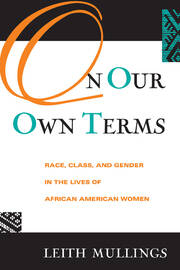
On Our Own Terms Race, Class, and Gender in the Lives of African-American Women
By Leith Mullings
Copyright 1997
224 Pages
by
Routledge
224 Pages
by
Routledge
Also available as eBook on:
This volume utilizes the cross-cultural, historical and ethnographic perspective of anthropology to illuminate the intrinsic connections of race, class and gender. The author begins by discussing the manner in which her experience as a participant observer led her to research and write about various aspects of African-American women's experiences. She goes on to provide a critical analysis of the... Read more
Contents; Acknowledgements; Preface; Introduction; Part 1. Women, Work, and Community; Introduction; 1. Notes on Women, Work, and Society; 2. Uneven Development: Class, Race, and Gender in the United States Before 1900; 3. Minority Women, Work, and Health; Part 2. Kin and Family; Introduction: Perspectives on the American Family; 4. Anthropological Perspectives on the African American Family; 5. Households Headed by Women: The Politics of Race, Class, and Gender; Part 3. Representation, Resistance, and Transformation: Theory and Practice in Politics and in the Academy; Introduction; 6. Images, Ideology, and Women of Color; 7. Mapping Gender in African American Political Strategies 8. Gender and the Application of Anthropological Knowledge to Public Policy in the United States; 9. Race, Inequality, and Transformation: Building on the Work of Eleanor Leacock; 10. Reclaiming Culture: The Dialectics of Identity
Biography
Leith Mullings is Professor of Anthropology at the Graduate School of the City University of New York. She is the author of Therapy, Ideology, and Social Change (1984), and editor of Cities of the United States (1987).
"Mullings' greatest offering is her transformational viewpoint, which presents fertile ground for real solutions to the problems faced by the African-American community.--Assata Zerai, Syaracuse University."
"...practical applications in the classroom, especially in the anthropology courses, where applying research on gender in restructured ways could help foster an understanding of social policy issues. The scholarly work in this book also can be valuable for other educational practitioners who would like to revamp their women-centered curricula, particularly those emphasizing disciplines, such as literature, history, health, and science." -- NWSA Journal
"Mullings' greatest offering is her transformational viewpoint, which presents fertile ground for real solutions to the problems faced by the African-American community.--Assata Zerai, Syracuse University."
