



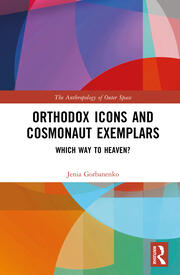
1st Edition
Orthodox Icons and Cosmonaut Exemplars Which Way to Heaven?
Prologue 1. Introduction 2. Cosmonautics, Cosmism, and Christianity 3. Which way to Heaven? 4. Space icons 5. Icon is a window into Heaven 6. Unsainted exemplars 7. Space awe as an icon 8. Sacred geography 9. Conclusion Bibliography Index
Biography
Jenia Gorbanenko is an anthropologist with a PhD from University College London. She is a former member of the ETHNO-ISS project, specialising in the study of religion and outer space.
“Situated at the intersection of Russian Orthodoxy and scientific cosmonautics, this groundbreaking and beautiful ethnography rethinks the legacy of Soviet materialism. The International Space Station and the Orthodox temple appear here not as opposing worlds, but as interconnected sites within a shared, modern landscape. Moving across churches, space museums, and orbital missions, the book develops an evocative account of contemporary cosmopolitics. It re-theorizes the icon as a ‘relationally immanent’ map of creation—one that turns rockets and spaceflight into unexpected paths toward the divine. Here, the ascent into space is not transcendence, but a detour that leads back to Earth, prayer, and the temple.”
- Alexei Yurchak, University of California, Berkeley
“Gorbanenko’s book is richly ethnographic, theoretically grounded, and written with clarity and depth. She offers a compelling account of how Russian Orthodox Christianity understands space exploration, carefully distinguishing between the ‘second sky’ of outer space and the uncreated Heaven of the ‘third sky’. Her icon-focused analysis, revealing a cosmos that is both spiritually compelling and potentially dangerous, contributes importantly to the anthropology of religion. By highlighting the relative coherence of Russian Orthodox interpretations of space in contrast to more fragmented Western frameworks, Gorbanenko invites a rethinking of how cultural, religious, and cosmological assumptions shape engagements with the heavens, and offers a model for comparable studies in other spacefaring contexts. At the same time, she offers a timely reminder that secular perspectives should not be mistaken for neutral ones.”
- Deana Weibel, Grand Valley State University
“This book offers an ethnography of Russian Orthodoxy and space exploration written from a consciously non-secular position. Following icons and cosmonauts to and from the ISS, the author brings Orthodox theology into dialogue with anthropology, challenging secular assumptions about religion, science, and knowledge itself.”
- Jeanne Kormina, Yerevan Center for International Education
