




1st Edition
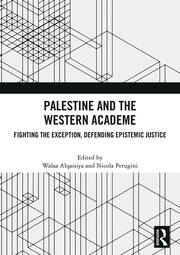
Palestine and the Western Academe Fighting the Exception, Defending Epistemic Justice
Introduction: Palestine and the Global Struggle for Epistemic Justice
Walaa Alqaisiya and Nicola Perugini
1. Resistance to Repression and Back Again: The Movement for Palestinian Liberation in US Academia
Lara Deeb and Jessica Winegar
2. ‘Axis of Evil’ and the Academic Repression of Palestine Solidarity
Somdeep Sen
3. Antisemitism and Zionism: The Internal Operations of the IHRA Definition
Neve Gordon
4. The Free Speech Exception to Palestine
Steven Salaita
5. Witnessing the Architecture of a Cancellation: The Silencing of Voices on Palestine in Austrian Academia
Author Collective scăpa شاهد, Alina Achenbach, Ruben Hordijk, Masawa Kawaumi, Masab Rood and Alexandra Tatar
6. Erasing Palestine in Germany’s Educational System: The Racial Frontiers of Liberal Freedom
Anna Younes and Hanna Al-Taher
7. Intent to Harm: Settler Colonial Outposts in Psychoanalysis
Lara Sheehi
8. Palestine Solidarity and Zionist Backlash in Australian Universities
Jumana Bayeh and Nick Riemer
9. Australian Universities in the Gaza Genocide: Managerial Capitulation, Staff and Student Resistance
Jumana Bayeh and Nick Riemer
10. A Land Acknowledgment in a Different Key: Palestine, Solidarity and the Disruption of the Liberal Script
Brenna Bhandar
11. The Coloniality of Academic Freedom and the Palestine Exception
Jairo I. Fúnez-Flores
12. Do Not Cower to Zionists: How Hillel International is Targeting Anti-Zionist Work on North American College Campuses
Maura Finkelstein
13. Scholasticidal Tendencies: Notes on Academia During Genocide
Basma Hajir and Mezna Qato
14. Palestine and the Ends of Theory
Max Ajl
15. Palestine is the Vanguard for Our Liberation: Insights from the Students’ Intifada at Columbia University
Dasha M., Luma Qashou, Parviz Behrangi, Caroline Reynolds and Amal Haddad
16. Becoming Combat Intellectuals: The Student Intifada at CUNY
Author collective CUNY for Palestine
17. Forging Anticolonial Solidarity in the Hour of Genocide Haki/Pláticas on Complicity, Dissent and Protest in a Belgian University
Omar Jabary Salamanca, Leila Mouhib, Elsa Roland, Jihane Mhand Yamna and Nathan Delbrassine
18. Still Balfour’s University: Upholding Al-Thawabet in the Face of ‘Necro-Bureaucracy’
Danya Delfs, Hajar Ibrahim and Suha Shroof
19. Balfour’s Imperial Legacy: Genocide and the Incommensurable Politics of Decolonial Redress
Shaira Vadasaria and Samer Abdelnour
Biography
Walaa Alqaisiya is a Scholar of Middle East Studies based at Northwest University in the People’s Republic of China. She received her PhD in Human Geography from Durham University (UK), and taught at the Department of Gender Studies, London School of Economics and Political Science (LSE, UK). Her research spans Indigenous ecologies, gender and sexuality studies, and decolonial theories. Her book Decolonial Queering in Palestine (Routledge 2022) examines how Palestinian queer politics challenge Zionist settler-colonialism while imagining a free Palestine beyond the Oslo impasse. Alqaisiya’s work appears in prestigious journals including Social and Cultural Geography, Political Geography, Radical Philosophy, and Palestine Studies. Building on research from her Global Marie Curie Fellowship across Ca’ Foscari University (Italy), Columbia University (USA), and LSE, she currently studies colonial ecocidal violence and Indigenous women’s ecologies from Palestine to Turtle Island. She serves on the editorial boards of Middle East Critique and Gender Place and Culture.
Nicola Perugini teaches International Politics at the University of Edinburgh (UK), focusing on international law, human rights, and violence. He co-authored The Human Right to Dominate (2015), Morbid Symptoms (2017), and Human Shields: A History of People in the Line of Fire (2020). His research spans war ethics, human rights politics, humanitarianism, refugee studies, and settler-colonialism. His current project, “Decolonising the Civilian,” examines decolonization, international law, and civilian status in armed conflicts. Perugini has held prestigious positions at Princeton’s Institute for Advanced Study, Brown University (Mellon Fellow), and as a Marie Skłodowska-Curie and Leverhulme Trust Research Fellow. He previously taught at the American University of Rome, Al Quds Bard College (where he directed the Human Rights Program), and University of Bologna. He has served as a consultant for UNESCO and UN Women. His opinion pieces have appeared in several publications including Al Jazeera, London Review of Books, Jewish Currents, and The Nation.
