




1st Edition
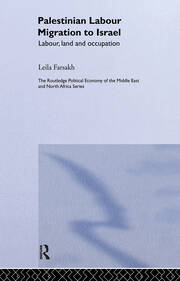
Palestinian Labour Migration to Israel Labour, Land and Occupation
Biography
Leila Farsakh is Assistant Professor at the University of Massachusetts in Boston and a research affiliate at the Center for International Studies at the Massachusetts Institute of Technology. She received her doctorate from the University of London and worked with the OCED in Paris and the Palestine Economic Policy Research Institute in Ramallah. Her research focuses on migration issues, the Israeli-Palestinian conflict and the political economy of the Middle East.
'Leila Farsakh provides a powerful contribution to our understanding of these issues...[She] has provided a valuable and thought-provoking contribution to the literature on the political economy of the WBGS. Her work moves far beyond a simple empirical analysis and is underpinned by a powerful methodological approach to understanding the factors shaping Palestinian economic development. It is richly deserving of a wide audience.' - Adam Hanieh, Journal of Palestine Studies, Vol XXXVI No 1, Autumn 2006
'The intricate interlacing of the variety of labor force statistics along with an acute understanding of Israeli policy reveals a work that is cogent and compelling.' - Edward A. Sayre, Middle East Studies Association Bulletin, Volume 40 Number 2, December 2006
