





1st Edition
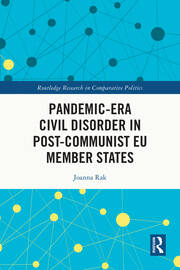
Pandemic-Era Civil Disorder in Post-Communist EU Member States
Part 1: Introduction
1. Towards Understanding of Civil Disorder during the Pandemic
2. Exploring Conditions of Civil Disorder Development: Theoretical Foundations
Part 2: Case Studies
3. Estonian Proactive Policing: Negotiated Management and Neutrality to Service of Civil Disorder Prevention
4. Unintended Consequences of Hybrid Protest Policing in Latvia
5. Lithuania Leveraging Negotiated Management and Non-Partisan Policing
6. Poland: Application of Partisan Policing and Negotiated Management in the Face of Civil Disorder
7. Czech Law Enforcement and the Benefits of Neutrality and Limited Intervention
8. Slovakia: Detentions, Force, and the Shift from Peaceful Protest to Civil Disorder
9. The Role of Hungarian Predictable Negotiated Management and Non-Partisan Policing in Maintaining Peaceful Protests
10. Inconsistent Law Enforcement in Romania: Civil Disorder Under Force-, Management-Based Hybrid, and Escalated Force Protest Policing
11. The Impact of Hidden Partisanship and Countermovement Violence Policing on the Dynamics of Civil Disorder in Bulgaria
12. Civil Disorder Dynamics in Slovenia: Protest Policing Resistant to Political Influences
13. Cohesive Law Enforcement: Sustaining Peaceful Protests through Negotiated Management and Apolitical Policing in Croatia
Part 3: Conclusions
14. Causal Relationships between Protest Policing and Civil Disorder in Post-communist European Union Member States during the Pandemic
Biography
Joanna Rak is Associate Professor of Political Sciences at the Faculty of Political Science and Journalism of Adam Mickiewicz University (Poznań, Poland). She is the principal investigator of the research project “Civil Disorder in Pandemic-ridden European Union,” financed by the National Science Centre, Poland. The laureate of the Barbara Skarga Scholarship, the START Scholarship by the Foundation for Polish Science, and the POLITYKA Scientific Awards.
