





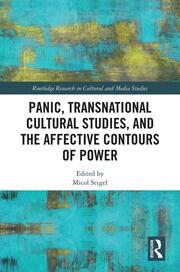
1st Edition
Panic, Transnational Cultural Studies, and the Affective Contours of Power
Acknowledgements
List of Figures and Captions
List of Contributors
Introduction, Micol Seigel
Part I. The Coloniality of Panic
Chapter 1: Privateers and Public Ends: Piracy as Global Moral Panic- Jatin Dua
Chapter 2: Moral Panic versus Moral Blindness: Responses to Children’s Militarization in Uganda and the US- Michelle Moyd, Frances M. Clarke, and Rebecca Jo Plant
Chapter 3: Ebola: Keywords- Adia Benton
Chapter 4: A Panicky Atmosphere: On the Coloniality of Climate Change- Alex Chambers
Chapter 5: The Panic over Human Smuggling: From the Nineteenth Century Coolie Trade to Today’s Migrants- Elliott Young
Part II. Too Mobile: Panic at the Borders
Chapter 6: Rescuing the Blonde Angel: The Global Captivity Narrative and the Panic of 2013- Susan Lepselter
Chapter 7: The Everywhere Drug War: Narcoterror and the Global Flows of the Methamphetamine Imaginary- Travis Linnemann and Kyra Martinez
Chapter 8: Black Bodies, Wrong Places: Rolezinho, Moral Panic, and Racialized Male Subjects in Brazil- Osmundo Pinho
Chapter 9: Circulating Sin: Sailors and Benevolence in Early Nineteenth-Century New York- Dana Logan
Chapter 10: Transnational Securityscapes: Central American (Immigrant) Youth and the ‘Military Option’- Elana Zilberg,
Part III. Resisting Rescue: Sex/Work
Chapter 11: Stop the Woman, Save the State: Policing, Order, and the Black Woman’s Body- Rudo Mudiwa
Chapter 12: Modern-Day Slavery: The Analogy Problem in Human Trafficking Reform- Julietta Hua
Chapter 13: Saving Love: Compassion, Desire, Violence, and Deceit in Late Capitalism- Courtney Mitchel
Chapter 14: And Still We Rise’: Moral Panics, Dark Sousveillance, and Politics Otherwise in the New New Orleans- Laura McTighe
Biography
Micol Seigel is professor of American Studies and History at Indiana University, Bloomington, and the author of Violence Work: State Power and the Limits of Police (Duke University Press, 2018) and Uneven Encounters: Making Race and Nation in Brazil and the United States (Duke, 2009).
