




1st Edition
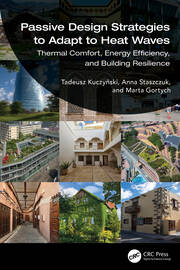
Passive Design Strategies to Adapt to Heat Waves Thermal Comfort, Energy Efficiency, and Building Resilience
1. Introduction 2. The Escalating Threat of Heat Waves in a Warming World 3. Frameworks for Assessing Building Thermal Comfort: Rating Systems, Standards, and Metrics 4. Thermal Resilience Systems and Indicators 5. Comprehensive Assessment of Passive Strategies: Environmental, Energy, and Economic Perspectives 6. Impacts of Outdoor Temperatures on Indoor Environments 7. Active Strategies for Mitigating Heat Stress in Buildings 8. Passive Cooling as an Alternative to Mechanical Air Conditioning Systems: Theoretical Foundations 9. Solar Shading Principles in Architecture: Climatic Logics and Built Examples 10. Thermal Mass Principles: Climate, Materiality, and Architectural Examples 11. Natural Ventilation Principles: Airflow Mechanisms and Climatic Applications 12. Integrated Passive Cooling in Vernacular Architecture: Synergies of Shading, Thermal Mass, and Natural Ventilation 13. Research in Passive Cooling Technologies 14. Research on Building Thermal Resilience 15. Year-Round Thermal Efficiency 16. Carbon Footprint Analysis of Single-Family Homes in Zielona Góra: The Impact of Climate Scenarios and Construction Choices 17. Innovative Building Solutions for Future Climate Challenges 18. Synthesis and Implications 19. Toward a Climate-Responsive Design Paradigm
Biography
Prof. Tadeusz Kuczyński is Professor of Building Physics at the University of Zielona Góra, where he has served as Dean, Deputy-Rector, and Rector. His research focuses on indoor climate, building energy performance, passive design, and renewable energy systems. He has co-authored numerous articles in leading journals and coordinated high-impact projects. Prof. Kuczyński is recognized internationally as an expert in sustainable architecture, energy efficiency, and passive strategies for climate adaptation.
Prof. Anna Staszczuk is Associate Professor at the University of Zielona Góra, Institute of Building Engineering, and Head of the Department of General Construction and Building Physics. Her research interests include indoor climate, energy use in buildings, and heat storage. She has authored numerous research papers and a book, and has been involved in national and international projects. Her current work emphasizes sustainable construction, energy-efficient design, and passive technologies for protecting buildings against overheating. Prof. Staszczuk also teaches courses in building physics and sustainable architecture and construction.
Dr Marta Gortych is Assistant Professor at the University of Zielona Góra, Faculty of Engineering and Technical Sciences, where she serves as Vice-Dean for Student Affairs. She holds MSc degrees in Chemical and Process Engineering and Environmental Engineering, and a PhD in Technical Sciences. Her research focuses on building energy efficiency, heat transfer, and the application of phase change materials in construction and energy systems. Her current work particularly focuses on passive strategies for improving thermal comfort in buildings. Dr Gortych has published in leading international journals and actively participates in international research projects.
"Passive Design Strategies to Adapt to Heat Waves offers a rigorous and timely roadmap for making buildings both comfortable in everyday use and safe during extreme heat events. By uniting clear comfort-and-resilience frameworks with rare full-scale monitoring and a broad comparative literature, it convincingly bridges theory and practice. The book draws on cross-climate lessons and vernacular case studies to show how shading, thermal mass, natural ventilation, and allied passive measures can extend safe indoor conditions while reducing reliance on vulnerable mechanical cooling systems. It is immediately useful to researchers, practitioners, and policymakers alike. Above all, this is the kind of book that becomes a go-to reference on every resilient design shelf."
Dr. Hao Sun, PhD, Research Fellow, Global Centre for Clean Air Research (GCARE), University of Surrey, UK, Part-time Research Associate, Building Energy & Environment Research Group, University of Nottingham, UK
"Passive Design Strategies to Adapt to Heat Waves: Thermal Comfort, Energy Efficiency, and Building Resilience is a timely and essential contribution to the growing discourse on climate-responsive architecture and sustainable urban development. As global temperatures rise and extreme heat events become more frequent and intense, the need for resilient building strategies has never been more urgent. This book addresses that challenge, offering a rich and multifaceted exploration of passive design techniques that enhance thermal comfort while reducing energy dependence. For professionals and researchers committed to advancing sustainable and climate-responsive design, Passive Design Strategies to Adapt to Heat Waves is more than a reference, it’s a roadmap. Highly recommended for anyone seeking to make meaningful contributions to the future of resilient architecture."
Professor Eng. José Carlos Almeida, Polytechnic University of Guarda, Portugal
"This book is an extremely valuable source of knowledge for architects, engineers, urban planners, and anyone interested in the adaptation of buildings to extreme climatic conditions. The authors discuss in detail passive design strategies that increase thermal comfort, improve energy efficiency, and strengthen the resilience of buildings to heat waves in a changing climate, and the need to protect the environment. With practical tips and numerous case studies from around the world, this publication is an invaluable tool in the pursuit of sustainable development and the creation of more climate-resilient buildings. I recommend it to all professionals and students who want to deepen their knowledge of green and energy-efficient solutions in modern architecture."
Professor arch. Piotr Herbut, University of Agriculture, Cracow, Poland
"This book presents a holistic approach to the problem of heat waves, with useful practical adaptive strategies to deal with the difficult situations created by it. With an original blend of theory and practice, it provides an interesting perspective that can serve as a basis for significantly improving building construction solutions. The book creates a framework of knowledge with the more relevant and updated theories related to measuring heat wave impact on thermal comfort and improving thermal building resilience as well as a carefully selected international case studies applying them, that can be very useful for all those involved in looking for the best design. Sustainable adaptation to the specific conditions requires local expertise that this book will help to develop."
M.A. Flórez de la Colina, Architect, PhD, P.T.U. Professor, Building Technology Department (Departamento: Tecnología de la Edificación), Universidad Politécnica de Madrid, Spain
"This book, Passive Design Strategies to Adapt to Heat Waves: Thermal Comfort, Energy Efficiency, and Building Resilience, offers a comprehensive exploration of passive cooling techniques, integrating empirical research, vernacular wisdom, and forward-looking life-cycle analyses. Its examination of thermal resilience metrics, including those from our work at Wuhan University, provides a framework for addressing the escalating challenges of overheating in a warming world. The authors’ interdisciplinary approach makes this an important resource for architects, engineers, and policymakers striving for sustainable and resilient building design."
Professor Zhonghua Gou, Wuhan University, China
"This book offers an excellent synthesis of strategies to mitigate urban overheating and improve building resilience during heat waves. It bridges scientific knowledge with practical design solutions, making it a highly relevant resource for both researchers and practitioners."
Dr. Haochen Tan, Assistant Atmospheric Scientist, Argonne National Laboratory, USA
"This book is an essential guide for building design in a climate-changing world. It expertly combines a review of decades of research, with an emphasis on field experiments, and an in-depth analysis of passive design strategies from both vernacular and contemporary architecture. This book clearly states that climate resilience is directly linked to passive cooling strategies, which are a crucial foundation for having comfortable and safe buildings during extreme heat events. It is an invaluable resource for practitioners, researchers, and policymakers alike who are seeking to build a more resilient future."
Rafael Monge Palma, Assistant Researcher, Department of Energy Engineering, School of Engineering, University of Seville, Spain
"Overheating in buildings is one of the most pressing challenges of our time. This book offers not only a comprehensive resource but also an invitation to rethink how we design for a resilient future. Grounded in the principles of passive resilience, this work provides a bridge between theoretical analysis and practical experience, making a significant contribution to the ongoing dialogue on climate-adaptive architecture."
Silvana Flores Larsen, Universidad Nacional de Salta—INENCO (UNSa- CONICET), Argentina
"Kuczynski, Staszczuk, and Gortych’s book provides a well-balanced combination of principles and practical ideas to design buildings that are better adapted to heat waves. Through its different chapters, it demonstrates that passive strategies are not just supplementary measures that can be implemented to enhance the performance of mechanical systems but can become foundational for adaptive building design in the twenty-first century. Passive Design Strategies to Adapt to Heat Waves: Thermal Comfort, Energy Efficiency, and Building Resilience is a welcome reference book for students, designers, and policymakers."
Pablo La Roche, PhD LEED BD+C AIA Assoc Professor Architecture, Cal Poly Pomona, USA
"This book highlights passive design strategies as a solution to the recent increase in energy consumption and carbon emissions. The extensive study on passive design strategies used in many areas around the world is important for the economy, health, and environmental sustainability. In this context, it is believed that this book will be an important reference source for architects, engineers, and other decision-makers in the field of sustainability."
Ruşen Ergün, Assistant Professor, Faculty of Architecture, Dicle University, Diyarbakır, Türkiye
