




1st Edition
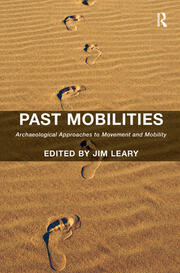
Past Mobilities Archaeological Approaches to Movement and Mobility
By Jim Leary
Copyright 2014
218 Pages
by
Routledge
218 Pages
by
Routledge
218 Pages
by
Routledge
Also available as eBook on:
The new mobilities paradigm has yet to have the same impact on archaeology as it has in other disciplines in the social sciences - on geography, sociology and anthropology in particular - yet mobility is fundamental to archaeology: all people move. Moving away from archaeology’s traditional focus upon place or location, this volume treats mobility as a central theme in archaeology. The chapters... Read more
Chapter 1 Past Mobility, JimLeary; Chapter 2 Past Movements, Tomorrow’s Anchors. On the Relational Entanglements Between Archaeological Mobilities, OscarAldred; Chapter 3 Enmeshments of Shifting Landscapes and Embodied Movements of People and Animals, MattEdgeworth; Chapter 4 Suspended Animations, Ursula K.Frederick; Chapter 5 GIS Approaches to Past Mobility and Accessibility, OulaSeitsonen, Jean-LucHoule, Lee G.Broderick; Chapter 6 Micro Mobilities and Affordances of Past Places, KirkWoolford, StuartDunn; Chapter 7 Mobility and the Skeleton, Thomas G.Davies, EmmaPomeroy, Colin N.Shaw, Jay T.Stock; Chapter 8 Women on the Move. The DNA Evidence for Female Mobility and Exogamy in Prehistory, Keri A.Brown; Chapter 9 Mobility in the Roman Empire, LienFoubert, David J.Breeze; Chapter 10 Travelling by Water. A Chronology of Prehistoric Boat Archaeology/Mobility in England, MarkDunkley;
Biography
Dr Jim Leary is Lecturer in the Department of Archaeology at the University of Reading, UK. He is co-editor of Round Mounds and Monumentality in the British Isles and Beyond, and co-author of The Story of Silbury Hill and Silbury Hill. The Largest Prehistoric Mound in Europe.
’A timely collection exploring what happens when movement is put at the centre of investigations into the archaeological record. We see the landscape as a fluid entity, the application of experimental methodologies, the inscription of movement on past bodies - in short, what past worlds look like from a mobile perspective. This is an exciting, challenging and innovative book addressing a topic at the forefront of archaeology.’ Gavin Lucas, University of Iceland, Iceland ’The strength of this volume is the effort of the authors to integrate the theoretical reflections on movement of Martin Heidegger, Tim Ingold, Chris Tilley and Ian Hodder with archaeological data from the Old World, Iceland, and Australia. This makes it a valuable contribution to the growing discussion on the significance of mobility in the past, present and future of humanity.’ Hans Barnard, Cotsen Institute of Archaeology at UCLA, USA
